
A Guide to The River Thames in London
Date post added: 10th July 2026
When you think of London, you tend to conjure up a city of streets. A maze of black cabs, red buses, Lime bikes and Tube lines. But when you look at London on a map there’s a single, standout feature – The River Thames that flows across the city from west to east.
London began as a river. Everything else came later. Long before there were trains or taxis, the River Thames was how London moved. Kings, criminals, merchants and monks all travelled its waters, usually for very different reasons.
Today the river’s still doing heavy lifting. It carries tourists past Big Ben, commuters past Canary Wharf and the occasional confused seal as far inland as Richmond.
In this guide, you’ll discover its history and geography. You’ll get a taste for the many London landmarks that line its banks. And you’ll also find out about some of the more hidden curiosities people tend to miss altogether.
Where does the River Thames start and end?
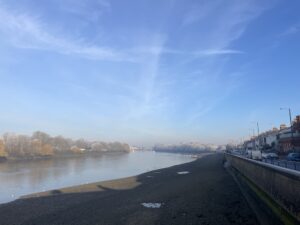
The River Thames is England’s longest river at 215 miles long from source to sea. It’s the second longest in the UK, after the River Severn. It’s probably its most famous river too. It starts as a mere trickle at Thames Head in Kemble, Gloucestershire. It ends at the wide-mouthed Thames Estuary with Essex on its north side and Kent to the south.
The Upper Thames starts from its source to Pangbourne in Berkshire and is 88 miles long. It includes parts of the Cotswolds, Oxford, Lechlade and Wallingford. This area’s where Kenneth Grahame, author of The Wind in the Willows, experienced life by the river.
The Middle Thames section flows through renowned riverside locations like Henley-on-Thames, Marlow and Windsor. The final stretch of the river runs from Old Windsor to Staines and on to Teddington Lock.
The eagle-eyed amongst you will realise that the River Thames doesn’t end in Teddington Lock. But it’s here that it turns from a non-tidal to a tidal river. Yes, the North Sea flows all the way into the centre of London. The tidal river flows out of London, past Tilbury Docks, and ends at Southend-on-Sea in Essex.
What is the history of the River Thames?
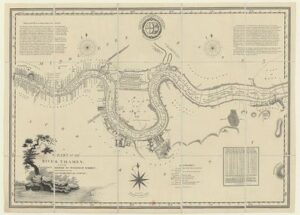
London without the River Thames is like tea without milk or Paddington without marmalade. They’re inextricably linked. London wouldn’t be here without the river.
Long before London had a name, people settled along the river’s banks. They were drawn there by food, trade and transport routes. The Romans spotted its potential and founded Londinium around AD 47.
Throughout the Middle Ages, the Thames was London’s main thoroughfare. Roads were dreadful (you think our potholes are bad, you should have seen their roads). So it made sense to travel by water instead. Boats carried everything: people, food, timber, silk and plenty of gossip.
The river shaped London’s growth as a global trading power. During the 17th, 18th and 19th centuries, the River Thames was one of the busiest waterways in the world. Vast docks lined the river, handling cargo from across the British Empire. The river was big business.
The Victorians reshaped it further with major engineering projects. The likes of embankments, reservoirs, bridges and improved docks. More recently, riverside London’s been reinvented again. Old warehouses became flats. Empty docks became museums. Industrial wastelands became some of the city’s most desirable postcodes. Like the river itself, the areas on its banks keep moving.
What are the best places to visit along the River Thames in London?

A stroll beside the river is one of our favourite things to do in London. From the maritime history in Greenwich to the historic seats of power in Westminster, there’s so much to see along the way. About 1000 years worth of history line the river’s banks.
Our photography expert and London Walks guide, David believes a walk beside the Thames is “a photographer’s delight, showcasing London’s captivating charm.” Just look at some of the iconic London landmarks you can capture as you walk alongside the river.
Tower of London
This incredible Medieval fortress has been protecting the city since William the Conqueror’s day. It’s been a royal palace, a prison, an execution site and the place where two princes mysteriously vanished. And the best way to discover the tower’s history is on our insightful Tower of London guided tour.
Tower Bridge
Right by the Tower of London, Tower Bridge is seriously striking. Built in 1894, it still opens for tall ships today, so check the lift times before you plan to walk across. You can also head up to the top of its towers for breathtaking panoramic views from its glass walkway.
London Bridge
It’s a lot less pretty than its neighbour, Tower Bridge. But historically, London Bridge was the only crossing point for over 600 years. The bridge you see today is not the one from the nursery rhyme. That one was sold to an American businessman in 1968 and is now in Arizona.
Borough Market
Food traders have worked this Borough Market site for over a thousand years. It’s survived fires, plagues and the Blitz. It’s your go-to market for artisan loaves, fruit and veg, and street food from around the world. Come hungry (but not hangry) and be prepared to jostle the crowds.
Shakespeare’s Globe
Right on the South Bank of the Thames, you’ll find Shakespeare’s Globe. It’s a faithful rebuild of the original 1599 theatre, just a few hundred metres from where Shakespeare’s actual Globe burned down in 1613. It was set alight when a cannon misfired during a performance of Henry VIII.
The Tate Modern and Millennium Bridge
Housed in a former power station, Tate Modern’s one of the world’s great galleries. And you can look around Tate Modern with our well-informed guide, Rick, each Wednesday. From there, you can cross The Thames via the Millennium Bridge to get to the magnificent St Paul’s Cathedral. And don’t worry, it’s not the ‘Wobbly Bridge’ it once was.
St Paul’s Cathedral
Christopher Wren’s masterpiece, St Paul’s Cathedral, was built after the Great Fire destroyed its medieval predecessor. You can discover its magnificence, and secrets, in detail on our St Paul’s Cathedral guided walk
The Houses of Parliament and Big Ben
One of the most recognisable, and impressive, buildings in London, the Houses of Parliament are right on the banks of the Thames. And you must get a photo in front of its clock tower, Big Ben. This is where big government decisions are made. You can find out more about that experience from an actual politician on our MP’s Westminster walk.
The London Eye
A relative newcomer to the London skyline, at a mere 26 years old, the London Eye is a popular sightseeing spot. It’s also an excellent vantage point for understanding how the whole river fits together.
Greenwich
Glorious Greenwich sits alongside the River Thames which goes to explain its rich maritime history. It’s also home to the Prime Meridian Line, the Cutty Sark and the Royal Observatory. You can stand here and have one foot in the Eastern Hemisphere and one in the Western. It also boasts our perfect London Walk – Classic Greenwich and London Boat Trip
Hidden London gems beside the Thames
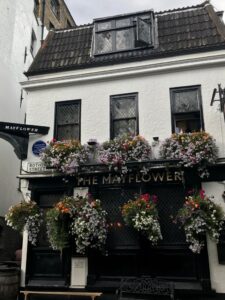
Now for some of the lesser-known spots along the River Thames in London.
- The Mayflower in Rotherhithe: This riverside pub stands close to the departure point of the Pilgrim Fathers’ ship before its voyage to America in 1620. Its timbered interior and riverside terrace make it one of the most atmospheric, historic pubs in London. Discover its legends and history on our Mayflower walking tour
- Wapping Execution Dock: It’s here that pirates and smugglers convicted by Admiralty courts were hanged. Their bodies were sometimes left suspended beside the river as a warning to others. Hear the grisly details on our Pirates, Press Gangs and Execution Dock walk
- Wapping Old Stairs: Near the Prospect of Whitby pub, you can see historic stairs leading up from the river bank. Before there were many bridges, Londoners relied on watermen to ferry them around the capital from stairs like these.
- Limehouse Basin: This is the meeting point of the Thames, the Regent’s Canal and the Lee Navigation. For over two centuries it’s been a gateway between London and Britain’s inland waterways.
- Thames Barrier: It’s one of the world’s largest movable flood defences. Opened in 1984, this East London construction protects London from tidal flooding.
- River habitats: You can spot wildlife along the Thames, even in its most urban stretches. Look out for the likes of otters, kingfishers, water voles, seals and eels. It’s even been known for dolphins and whales to find themselves in the River Thames waters, albeit slightly disorientated.
Our River Thames walks

Join us to hear the tales from the riverbank in London.
- Thames Sightseeing: Brunel river cruise
- The Power of the Thames: Battersea to Westminster
Undiscovered London - Along the Thames pub walk
Pirates, press gangs and Execution Dock - Rotherhithe and the Mayflower
Private walks
These unscheduled walks can be booked as private tours. That means smaller groups and tailored talks. Contact us to arrange your private tour beside the Thames.
- Building and rebuilding the Thames Embankment
- East India Docks and Thames Docklands
- Limehouse and Thames Docklands
- The Embankment Story
- Bankside: Brothels and the Bard
- Towpath walk: Royal Victoria Dock to East India Dock
Who were the River Thames watermen?

The Company of Watermen and Lightermen was founded in the 16th century and still exists today.
Before London had its hugely knowledgeable cabbies or even Uber drivers, it had watermen. They ferried passengers across and along the Thames to their desired destination.
What is the Port of London Authority?
The Port of London Authority (PLA) is the organisation responsible for managing the tidal Thames. It was established in 1909 and oversees navigation, safety and environmental management along the River Thames.
What are the best spots for sightseeing along the River Thames?
There’s such a diversity of landmarks and beauty spots along the entire length of the River Thames. There’s the natural beauty of the Cotswolds and Chiltern Hills at its source. The renowned boating holiday and regatta hotspots of Henley-on-Thames and Marlow. The historic sites of royal Windsor Castle, Eton College and Runnymede where Magna Carta was drafted in 1215. That’s before you’ve even reached London and the likes of the South Bank, the Houses of Parliament, Tower Bridge and the Tower of London.
What are the best boat tours on the River Thames?
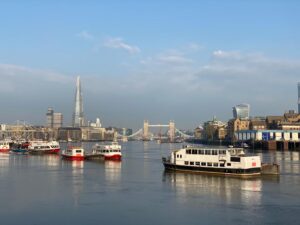
Call us biased, but we highly recommend our Thames Sightseeing river cruise where you explore major London landmarks as well as Brunel’s engineering achievements.
Leisurely narrowboat tours aren’t allowed on the tidal Thames, but can be enjoyed on its adjoining Lee Navigation or Regent’s Canal.
Which rivers or tributaries flow into the Thames?
The main ones are the River Kennet, Coln, Churn, Evenlode, Lea, Leach, Loddon, Ock and Windrush.
Has the River Thames ever flooded?
Yes. Since Roman times, London’s been faced with the threat of flooding. That’s why the Thames Barrier was implemented in 1982. It can be raised at high tide to manage the flow of water.
All along the Thames, there are locks and weirs to control the river’s flow. They’re designed to prevent flooding on particular reaches and to maintain navigation depths. The Environmental Agency manages this.
Has the Thames ever frozen over?
Not in recent times, but it was a regular occurrence centuries ago. Londoners used to take advantage of the waterway freezing over by holding Frost Fairs on its icy surface.
Walk the Thames with us

The longest river in England, the River Thames flows past major London landmarks as well as areas of outstanding natural beauty. It even has a national trail, the Thames Path that follows its entire length.
At London Walks, we find the waterways of London endlessly fascinating. And the River Thames is the headline act. Join us for a pub walk along the Thames, our classic river cruise or the Thameside walk from Battersea to Westminster. Fancy a waterside walk with added blood-splattering? Discover tales of pirates, press gangs and executions.

Pippa Jackson
Pippa is a word nerd and content aficionado with a background of working in TV on both sides of the globe. She loves to discover and share the diverse and wonderful stories of her much-loved London. When she’s not writing blogs and articles, you’ll find her walking beside the Thames or even paddleboarding on it (in the finest of conditions only!) or enjoying a coffee in the sunshine with a good book.

David Tucker
David – the Seigneur of this favoured realm – broods over words, breeds enthusiasms and is “unmanageable.”* He’s a balterer, literary historian, university lecturer, journalist, logophile and lifelong thanatophobe. For good measure, he’s the doyen of London guides.