
The 13 Ghosts Of The Tower Of London
Date post added: 8th October 2026
It was William The Conqueror who ordered for The Tower of London to be built (the White Tower part anyway). So, the Tower of London houses centuries of royal history. And some of that history is really rather gruesome. Treason, murder and execution, the stone walls of the Tower of London have seen it all. Little wonder then, that this historic royal palace cum execution site is one of the most haunted places in all of Great Britain.
The Tower of London would be a brilliant setting for the much-loved TV comedy, Ghosts! Numerous people have died at the tower, and many believe that it’s haunted by their spirits. These are the tales of those people who met decidedly grisly ends in the Tower. Here are the 13 ghosts of the Tower of London, in all their gory glory.
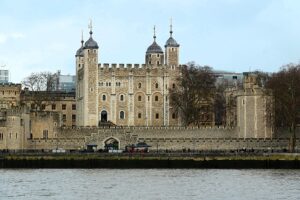
What is the Tower of London?
Standing majestically on the north bank of the River Thames in the City of London, the Tower of London is a historic royal palace. Today, it’s known as the place to see Beefeaters (Yeoman Warders), ravens and the Crown Jewels (not just a crown by the way, there’s the orb and sceptre too). But in its time, it’s also been a Royal Mint, an armoury and a treasury too.
Built by William the Conqueror in the 11th century to defend and secure his status as King of England, the Tower of London both a magnificent fortress and a royal palace too. It also became the backdrop for some of the grisliest scenes in history. In Tudor times, it saw the execution of three English Queens; Anne Boleyn, Catherine Howard and Lady Jane Grey. A mother beheaded for the sins of her son. The supposed murder of the two young princes locked up in the Bloody Tower by their uncle, the Duke of Gloucester. We told you the tales were gruesome.
Who haunts the Tower of London?
There are royal ghosts, criminal ghosts, an animal ghost and even an unidentified ghost linked to the majestic Tower of London.
1. Guy Fawkes
Guy Fawkes (of Bonfire Night fame) was taken to the Tower of London after his part in a plot to assassinate James I at Parliament in 1605. Imprisoned in the Queen’s House, Guy Fawkes was subjected to intense torture, likely on the rack in the White Tower dungeons. Can you hear his screams?
2. Anne Boleyn’s procession
As ghost stories go, there are few as spooky, and as tragic, as this one. Henry VIII broke with the Roman Catholic Church to set aside his first wife, Katherine of Aragon, and become the Supreme Head of his new church, the Church of England. Anne Boleyn then became Henry’s second wife. Just three years later, Anne was accused of adultery and taken as a prisoner by barge along the River Thames to the Tower of London, through the infamous Traitor’s Gate. Anne was beheaded on Tower Green and laid to rest in the Chapel Royal of St. Peter ad Vincula (St. Peter in Chains), the parish church of the Tower of London. Some 340 years later, a soldier reported seeing a light burning in the closed chapel. After climbing to a window to look within, the soldier’s said to have seen a paranormal procession of knights and ladies, led by a headless Anne Boleyn. His isn’t the only sighting. A supernatural lady in white, with a sad expression, has been seen in the tower grounds, severed head in hand.
3. Henry VI
As the War of the Roses got going, Henry VI was deposed and imprisoned in the Wakefield Tower of the Tower of London by his ambitious nephew, the future King Edward IV.
That wasn’t enough and Henry VI was murdered at the altar in the King’s Private Chapel in 1471, close to midnight. The royal ghost of King Henry VI is believed to haunt the Wakefield Tower, appearing at the stroke of midnight.
4. The ghost of a bear
Henry III housed his menagerie of wild animals at the Tower of London. That included a gift of either lions or leopards from the Holy Roman Emperor Frederick II in 1235. Pumas, tigers, jackals, an elephant from France and even a polar bear followed. Visitors came to the Tower to see the creatures with bear baiting becoming a popular pastime in 16th and 17th century London. And it seems the horrors of this pastime are still heard today. The ghost of a bear is said to appear from behind the door of The Jewel Room, perhaps a spectre guard to The Crown Jewels? The ghost of a black bear is also reported to have appeared near the Martin Tower in 1816.
5. Sir Walter Raleigh
Sent to the Tower no less than three times, explorer Sir Walter Raleigh was imprisoned by both Elizabeth I and James I. He spent over 13 years in the Bloody Tower during one confinement, and attempted suicide. Sir Walter Raleigh’s last imprisonment at the Tower of London, in the Beauchamp Tower, took place in 1603. He was later beheaded outside the Palace of Westminster.
6. The faceless young woman
In 1957, Welsh Guardsman Johns was on sentry duty at the Salt Tower. He encountered a shapeless form with the face of a young woman, perhaps one of the many women who suffered a terrible fate at the Tower of London.
Talking of female ghosts, there’s a ‘grey lady’ ghost who only appears to women. She haunts another historic royal palace, Hampton Court Palace.
7. Margaret Pole
Like Anne Boleyn, the beheading of Margaret Pole, Countess of Salisbury took place on Tower Green, to the west of the White Tower. Margaret Pole was 67 at the time of her death. She was brought to the scaffold by Henry VIII for the crime of being the mother of Cardinal Pole. And Cardinal Pole’s crime was opposing Henry’s self-created position as Supreme Head of the Church of England. Eyewitnesses say the executioner on that fateful day in 1541 was a “wretched and blundering youth” who, unable to perform a clean execution with his axe, instead hacked at Margaret Pole’s head and shoulders. That eternal scream echoes through the towers today.
8. The white figure
The Tower of London is protected by the Yeoman Warders, nicknamed Beefeaters. In 1864, Captain J.D. Dundas observed a Yeoman attempting to charge a ‘whitish, female figure’ with his bayonet. Chillingly, this apparition appeared in the courtyard where Anne Boleyn was beheaded.
9. Lady Jane Grey
Lady Jane Grey became Queen after the death of King Edward VI, son of King Henry VIII. She’s known as the English queen with the shortest reign of a mere 9 days.
Edward named Lady Jane Grey as his heir in his last will, over his half-sister Mary. A pawn in Royal power games, the King’s protector John Dudley had arranged for the 16 year old Lady Jane Grey to marry his son, Lord Guildford Dudley. On Edward’s death on 6th July 1553, Protestant Lady Jane Grey became queen. She held the title for just over a week before the Tudor court decreed that Catholic Mary was the true ruler of England. Lady Jane Grey, and her husband Dudley, were executed on the infamous Tower Green in 1554. The white figure of Lady Jane is said to haunt the battlements of the Tower of London to this day.
10. The monk’s footsteps
If you visit the Tower of London, listen out for the sound of sandals slapping against the stone floors. It’s not a Beefeater in flip-flops. It’s reported to be the steps of a ghostly monk.
11. Arbella Stuart
An oft-repeated ghost sighting at the Tower of London is that of Arbella Stuart, cousin to Elizabeth I. Arbella was imprisoned by James I for marrying William Seymour, nephew of Lady Jane Grey, without royal consent. Seeing this match as a possible threat to his throne, James placed Arbella under arrest at the Tower. There, she either refused to eat or was starved deliberately. Arbella’s ghost is thought to stalk the Queen’s House.
12. The young princes
On the death of Edward IV, Edward’s young son, 12-year-old Edward became King Edward V, under the protection of his uncle, the Duke of Gloucester. Wanting to take the crown himself, the Duke of Gloucester imprisoned Edward and his young brother Richard (the Duke of York) in the Tower of London. Their mother, Elizabeth Woodville took sanctuary at Westminster Abbey. After declaring young Edward illegitimate, the Duke of Gloucester became King Richard III. The princes in the tower – Edward and Richard – were never seen again, believed to be murdered at the order of their uncle. The bones of two children were later found beneath a staircase in the Tower of London.
13. The nameless thing
Lastly, the ‘nameless thing’ is a petrifying spirit which follows the guards of the Tower as they walk their beat from the River Thames’ Sally Portal entrance.
Who is buried at the Tower of London?
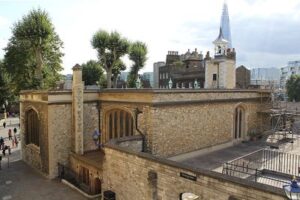
The chapel of St Peter ad Vincula at the Tower of London” by Richard Nevell is licensed under CC BY-SA 3.0 Unported.
Three Queens of England, Anne Boleyn, Catherine Howard and Jane Grey, were buried at The Chapel of St Peter ad Vincula. All three of these ladies were executed at the Tower of London in the 16th century.
Joining the ladies are 16th century Bishop of Rochester, John Fisher and Henry VIII’s chief advisor, Thomas More. Again, both were executed in 1535 for refusing to declare the King the Supreme Head of the Church. Tudor London was brutal!
Who was the last person to be killed at the Tower of London?
You may be surprised to learn how recently somebody was killed at the Tower of London. On 15th August 1941, Josef Jakobs was executed by firing squad there. His crime? He was found guilty of spying for Germany during World War II.
Can you name the two little boys whose ghosts walk hand in hand down the staircase of The Bloody Tower?
Yes, and we will. Their names are Edward and Richard – King Edward V and his younger brother Richard, Duke of York. Otherwise known as the two princes in the tower.
Which monarch haunts the Wakefield Tower?
King Henry VI was murdered at the altar in the King’s Private Chapel in 1471. It’s Henry’s royal ghost that’s believed to haunt the Wakefield Tower.
A terrifying tourist attraction since the 18th century
The Tower of London has been a tourist attraction since the 18th century. You can experience the chilling atmosphere by visiting the Tower yourself. Better yet, join us on a London Walks tour of the Tower of London where our expert guides will reveal even more chilling tales of the ghostly and supernatural.
Historic London is the most haunted city around. Join us on a series of ghostly tours where we’ll share some seriously chilling tales.

Pippa Jackson
Pippa is a word nerd and content aficionado with a background of working in TV on both sides of the globe. She loves to discover and share the diverse and wonderful stories of her much-loved London. When she’s not writing blogs and articles, you’ll find her walking beside the Thames or even paddleboarding on it (in the finest of conditions only!) or enjoying a coffee in the sunshine with a good book.

David Tucker
David – the Seigneur of this favoured realm – broods over words, breeds enthusiasms and is “unmanageable.”* He’s a balterer, literary historian, university lecturer, journalist, logophile and lifelong thanatophobe. For good measure, he’s the doyen of London guides.