
Our Limehouse Cut Guide
Date post added: 20th May 2026
The Limehouse Cut in East London is steeped in industrial history. It has two particularly notable features. It’s really straight and it’s really old. The two mile stretch of water dates back to 1770 making it the oldest canal in London.
The Limehouse Cut links the River Thames at Limehouse Basin to the River Lea in Bromley-by-Bow. Now this is a canal with a purpose. It knows what it has to do and it gets on with it. There’s no scenic meandering here. The Limehouse Cut takes a bold, straight line through the East End’s ever-changing landscape.
During its 260 year existence, this area’s seen huge change. There have been times of incredible industrialisation. It’s been a major transport network. And more recently, urban regeneration.
The Limehouse Cut is one of London’s most underrated waterways, but it’s steeped in fascinating stories and is well worth exploring.
What is the history of Limehouse Cut in London?
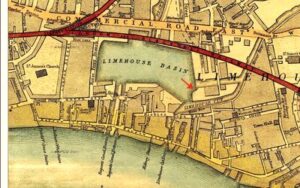
The Limehouse Cut has a strong claim to fame as London’s oldest canal. It opened in 1770.
Before it existed, boats travelling down the River Lea had to follow the long, looping and tidal route around Bow Creek to reach the River Thames and the City of London. This was slow, unpredictable and often dangerous. The solution was to dig a shortcut and avoid those precarious bends. Hence, the straight and direct canal that is the Limehouse Cut.
Yes, there are more picturesque canals around. But the Limehouse Cut was built for efficiency rather than postcard-prettiness. That’s part of its character. It cuts through East London in a no-nonsense manner.
The Limehouse Cut took 16 months to build. It was the first London canal to be created. When the Limehouse Cut opened in 1770, London was booming. Its population was growing fast. The canal played an important role in moving goods into London. The canal became part of a wider system centred on the River Lee Navigation, bringing commodities down from Hertfordshire and beyond straight into the City of London.
In 1820, Limehouse Basin (then named the Regent’s Canal Dock) opened. It was an important hub where boats could dock, load and unload. There, freight would be transferred between barges that travelled along the new Regent’s Canal and onto the network of waterways.
As the 19th century progressed, the character of the canal began to shift. Instead of just bringing products into London, it also served the factories that stood along its banks. The waterway became part of East London’s industrial backbone, serving mills, warehouses and industrial works. It became a working corridor rather than just a supply route.
By the mid-20th century, the canal and surrounding docks had fallen into decline. Industry had moved out. The East London waterways were barely used. But then in the 1980s, the London Docklands redevelopment took place. New life was breathed into the area. Transport was key to this revival. The opening of the Docklands Light Railway suddenly connected this once-isolated area to central London. Local infrastructure including the Blackwall Tunnel also reshaped how people moved through the area. Add to that further regeneration in the lead up to the 2012 London Olympics in East London.
So today, the areas around the Limehouse Cut, especially near Poplar and along Burdett Road, feel like a blend of industrial heritage with modern waterside developments.
What to see near the Limehouse Cut
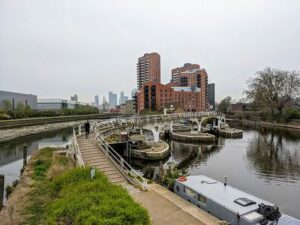
“Bow Locks” by The wub is licensed under CC BY-SA 4.0.
We’re big fans of stepping off crowded pavements and onto quieter towpaths. Walking beside water is a wonderfully mindful experience. And whilst this canal is only two miles long, there’s plenty to take in along the way.
Bow Locks
At the northern end of Limehouse Cut, Bow Locks mark its meeting point with the River Lee. This is where the canal connects with the wider Lee Navigation. The historic lock regulates water levels between the canal and the tidal Bow Creek.
Neighbouring Old Ford Lock, specifically its lock-keeper’s cottages, were home to The Big Breakfast TV show in the 90s. They still stand today.
Queen Elizabeth Olympic Park
Stratford was once a forgotten part of London. But the 2012 London Olympics changed all that. The regenerated area’s now a jaw-dropping contrast of old and new. The Olympic Park was a major part of that redevelopment and is home to the stadium, the aquatics centre, the velodrome. But it’s also a centre for culture with the new V&A East Museum, Sadlers Wells and a programme of diverse cultural events.
The nearby Victoria Park is a popular East London spot. It’s the largest park in Tower Hamlets, complete with glorious gardens, a lake, playgrounds and outdoor classroom.
Industrial heritage
As you walk alongside the waterway, look out for surviving hints of the canal’s working past. You can still spot the remains of old walls, wharves and bridges that once served East London’s factories and warehouses.
At the Bromley-by-Bow end of the canal, you’ll find Three Mills Island. The House Mill, dating back to 1776, is the largest surviving tidal mill in the UK.
On the eastern side of the Limehouse Cut, you can see Spratt’s Patent Limited factory. In the early 20th century, it was the largest dog food manufacturer in the world. It was here that vast quantities of fish heads would be delivered to be regurgitated into pet food. Oh, and they also made biscuits here.
Across the water, you’ll find a railway bridge and the remains of a wharf. Whilst it’s no longer in use by barges, it is frequented by local wildlife and has become an important habitat.
Stinkhouse Bridge
Don’t you love a good nickname? Bow Common Lane Bridge earned the moniker “Stinkhouse Bridge” at the height of the industrial era. The air would have been a heady mix of smells including tar, ammonia, animal parts, rubber and bone. So Stinkhouse Bridge makes perfect sense.
Commercial Road Bridge
Commercial Road was once a key route linking the City of London with the docks. It remains heavy with both traffic and history. Commercial Road Bridge is a major crossing over the Limehouse Cut.
Isle of Dogs
As you walk east towards Limehouse, cast your eyes over to the Isle of Dogs. That view’s where the London skyline shifts from low industrial buildings to the gleaming towers of Canary Wharf. It’s a striking contrast between old and new.
Limehouse Basin
At its southern end, the canal meets Limehouse Basin. These days it’s a lively marina and popular mooring. It’s where inland waterways connect to the River Thames. Boats, bars and waterside cafés create a completely different atmosphere from the industrial cut. Limehouse itself has an incredibly rich history. We explore this and more on our Limehouse – Thames – Docklands walk
What activities can you do on the Limehouse Cut?

_-_2022-03-28.jpg)

Walking
A full walk along Limehouse Cut takes around 30–40 minutes. It’s a perfectly doable, standalone stroll. But you can also extend that to a longer route covering the River Lea, Regent’s Canal or the Thames Path.
Our London canal walks are led by hugely knowledgeable inland waterway experts. You should try them!
Cycling
The towpath’s pretty wide and flat, making it a lovely cycling link through East London. No need to dodge the London traffic on your way to work or on a leisurely ride for pleasure.
Boating
It’s not the industrial transport network it was originally. But the canal’s still used by narrowboats travelling between the Lee Navigation and the River Thames. It’s a relatively quiet and straight stretch of water, so it’s a good place to canoe, kayak or paddleboard.
Photography
The cut’s straight alignment creates striking views. Reflections of modern buildings juxtaposed by industrial heritage and big London skies result in stunning images.
There’s also beautiful local wildlife on the banks of the water too. You can capture incredible shots of urban species here. Think otters, bats and foxes; kingfishers, swans, herons and cormorants.
Our East London canal walks

We offer 25 different canal walks in partnership with the Inland Waterways Association. It means you’ll be with an expert canal guide, a member of the IWA. It also means they’ll be highly informative and fun.
- Limehouse – River Thames – Docklands: starts at Westferry DLR station
- The Regent’s Canal – Mile End to Limehouse: from Mile End station to Limehouse DLR station
- The Regent’s Canal – Mile End to Haggerston: from Mile End station to Haggerston overground
- North Queen Elizabeth Olympic Park: starts at Stratford station
- Royal Victoria Dock to East India Dock (private tour)
- River Lee Navigation – Enfield to Ponders End (private tour)
- Discover more of our London canal walks
How long is the Limehouse Cut?
It’s only about two miles long. It starts in North East London at Bow Locks (where the Lee Navigation meets Bow Creek). It flows through Tower Hamlets and south east to Limehouse Basin.
The shortest London canal is the Hertford Union Canal which is a mere mile long.
Can you walk along Limehouse Cut?
Yes, there’s a walkway alongside the canal. You can start your walk at either the Thames Lock near the Limehouse Basin or from Three Mills in Bromley by Bow.
What are the main attractions along Limehouse Cut?
The main highlights include Limehouse Basin, Bow Locks and the canal’s industrial heritage. It highlights a rich contrast between historic infrastructure and modern East London. And, of course, the relative tranquility of a waterside towpath in a busy, urban area.
Take a London canal walk with us
Join us on a guided walk beside the waterway. Our hugely experienced canal guides will help you to discover the hidden details you might otherwise pass by.
Explore our guide to the best London canal walks

Pippa Jackson
Pippa is a word nerd and content aficionado with a background of working in TV on both sides of the globe. She loves to discover and share the diverse and wonderful stories of her much-loved London. When she’s not writing blogs and articles, you’ll find her walking beside the Thames or even paddleboarding on it (in the finest of conditions only!) or enjoying a coffee in the sunshine with a good book.

David Tucker
David – the Seigneur of this favoured realm – broods over words, breeds enthusiasms and is “unmanageable.”* He’s a balterer, literary historian, university lecturer, journalist, logophile and lifelong thanatophobe. For good measure, he’s the doyen of London guides.