
A Guide to Bow Back Rivers
Date post added: 19th August 2026
Ask most Londoners about Bow Back Rivers and you’ll get a blank stare. But when you ask a canal person, you’ll see their eyes light up. This tangle of waterways in East London is a well-kept secret.
This series of interconnected waterways may be largely forgotten now. But in their heyday, they played a major role in transportation. Enchanting names like Waterworks River, Pudding Mill River and City Mill River give a nod to that industrial past.
The area today is almost unrecognisable, overshadowed by the 2012 Olympic site and surrounding developments. But when you know where to look, you can still find remnants of the area’s interesting history.
Where and what are The Bow Back Rivers?
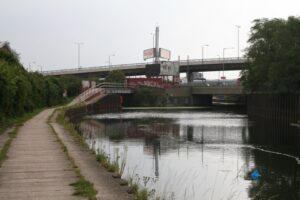
Dr Neil Clifton / Lee Navigation: mouth of Bow Back River / CC BY-SA 2.0
The Bow Back Rivers connect the River Lea to the River Thames. It’s where the River Lee Navigation (the canalised section of the River Lea) separates into multiple channels. Basically, the River Lea arrives from the north. Rather than picking a single route to the River Thames, it dithers and divides into a series of channels instead.
The rivers in this system include Abbey Creek, Channelsea River, City Mill River, Prescott Channel, Pudding Mill River, Saint Thomas Creek, Three Mills Back River, Three Mills Wall River, Old River Lea (or Old River Lee) and Waterworks River. Then, at Bow Creek, the rivers flow into the River Thames.
The whole Bow Back Rivers network covers an area roughly the size of the City of London. You’ll find it in an East London triangle between Stratford, Bromley-by-Bow and Hackney Wick.
A brief history of the Bow Back Rivers in London

Alfred the Great
There are signs that these rivers were used as early as the Bronze Age. Legend says that Alfred the Great diverted the river here in 896 to strand a Viking fleet. That forced the raiders to flee on horseback.
It was King Henry I’s wife, Queen Matilda, who paid for the bow-shaped bridge (Bow Bridge) to be built in 1110. There’s a tale that this was after she took an unplanned dip crossing the ford. Matilda (or Maud) neither confirmed nor denied such a story of soggy stockings.
Not long after, monks from Stratford Langthorne Abbey spent the medieval period draining the Stratford marsh and cutting channels to drive water and power watermills.
By the 18th and 19th centuries, barges were hauling timber, coal and grain along here to feed a fast-growing London. Bow Back Rivers played a major role in providing water to local industry. The tidal flow was harnessed to turn watermills at Three Mills. One of those mills still stands. It’s reckoned to be the largest surviving tide mill of its kind.
In the 1930s, major work happened to help with flood control. Namely, the River Lee (Flood Relief) Act, 1930. But by the 1960s, boats were no longer using the rivers for trade. They were written off as having no economic future. Industry’s loss was nature’s gain though. Wildlife like kingfishers, herons and grebes moved back in when trade moved out.
An upturn came in 2005, when London won its bid for the 2012 Olympic Games. Between 2005 and 2012 more than £50 million was poured into resurrecting the waterways. Locks were upgraded, habitats recreated and towpaths reopened. Part of Pudding Mill River was filled in. Three Mills Lock was built on the Prescott Channel. City Mills Lock was repaired. But Carpenters Road Lock wasn’t repaired until after the Olympics.
And then in 2012, David Beckham roared down the Waterworks River by speedboat to hand over the Olympic torch at the opening ceremony.
What to see around Bow Back Rivers
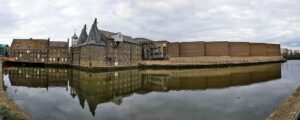
“Three Mills panorama – 2022-04-03” by The wub is licensed under CC BY-SA 4.0.

Three Mills
One of the most iconic sites on the Bow Back Rivers is the Three Mills complex. It’s a cluster of cobbled streets, 18th century buildings and a working tide mill. Originally the mills ground corn and gunpowder. The mill you see today milled grain for gin distilling.
Old Ford Lock
It’s actually a trio of locks – Top, Middle and Bottom – doing exactly what they say on the tin. Top Lock is Grade II-listed and sits near a cast-iron 1830s footbridge. Bottom Lock has a gritty, urban look that’s made it a favourite with film crews (you may recognise it from Big Breakfast days).
Queen Elizabeth Olympic Park
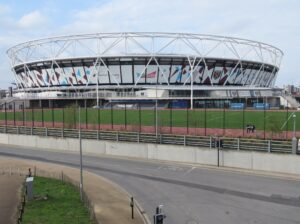
The revitalisation of the Bow Back Rivers was closely linked to the development of the Queen Elizabeth Olympic Park. The 2012 Olympic stadium is now West Ham’s home ground and sits on an island effectively formed by the Bow Back Rivers. It’s worth a visit for the acres of parkland and sports facilities. Not forgetting, the ArcelorMittal Orbit sculpture which doubles as the world’s longest and tallest tunnel slide.
The Greenway
In the 1860s, renowned engineer Joseph Bazalgette threaded his Northern Outfall Sewer across the channels and on to Abbey Mills Pumping Station. That embankment is now a public footpath called The Greenway. So, you can literally walk along the top of a Victorian sewer while admiring the wildflowers.
Bow Locks
Bow Locks connect the Bow Back Rivers to the tidal River Thames. There’s been a set of tidal gates on this spot since at least 1307, so it’s one of the oldest working crossings in the system. The current lock dates from 1852 and a second lock was added in 1931.
Bow Creek’s tidal all the way down, so these gates do proper work. They hold back the Thames’ rise and fall so the calmer waters upstream stay navigable. Higher floodgates were added in 2000 for extra insurance. It’s not the prettiest spot around, ringed by gasworks and trading estates. But it’s the hinge the whole waterway swings on. Do stop to admire several hundred years of tidal engineering still doing its job.
Carpenters Road Lock
The crown jewel of the 2000s’ restoration is Carpenters Road Lock. It reopened in 2017 after a £1.8 million rebuild. The lock comes complete with distinctive radial gates that double as flood defences. It’s the kind of clever engineering that canal people get very excited about. And it lets boaters navigate a full loop around the park.
What activities can you do around the Bow Back Rivers?

Play: The Olympic Park makes an incredible playground. There’s oodles of activities to try out here.
Walk: We always recommend a walk along a towpath. It’s good for mind, body and soul. If you’d like some company and local insights, book a London canal walk with our knowledgeable guides.
Cycle: Take a bike ride along the towpath and avoid the busy, London traffic.
Boat trip: Cruise along the waterway by boat. There are guided boat tours so you can leave someone else to navigate the Bow Back Rivers. Moorings are available at Three Mills.
Drink: Stop for a pint, a cuppa and a bite to eat. The Crate Brewery, The Milk Float, Number 90 and Print House Bar & Kitchen are all waterside venues that come recommended.
Our East London Canal Walks
Hear tales from the riverbank. Learn more about the centuries of history on London’s waterways. Our knowledgeable guides know these inland waterways like the backs of their hands.
We run private tours as well as our scheduled guided walks. Join one of our London canal walks or contact us to arrange a tailored private group tour.
The Olympics, Three Mills and Bow Back Rivers walk
Meeting point: Bromley-by-Bow tube station
Run as a private tour, this walk will show you the highlights we’ve mentioned in this guide. From the relatively recent Olympic park to the centuries-old mills and the river running through it.
The Secrets of the Northern Queen Elizabeth Olympic Park
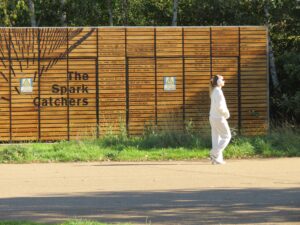
Meeting point: Stratford underground station
Discover lesser-known tales of the Olympic Park; its history and contemporary tales. This walk only takes place occasionally, but we also offer it as a private tour.
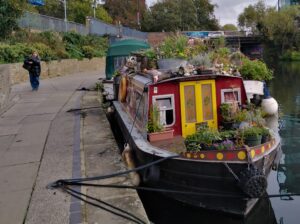
The Regent’s Canal: Mile End to Limehouse
Meeting point: Mile End underground station
You’ll be introduced to a London where time slows right down – to the pace of horse-drawn canal barges. Discover a London from 200 years ago. And then the gateway to the UK canal network at Limehouse. This walk only takes place occasionally, but we also offer it as a private tour.
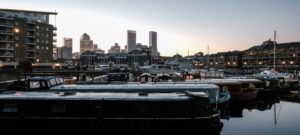
Limehouse – River Thames – Docklands
Meeting point: Westferry DLR station
The historical pickings don’t come much richer than at Limehouse Basin. We explore this area that’s transformed dramatically over the years and has endless stories to tell.
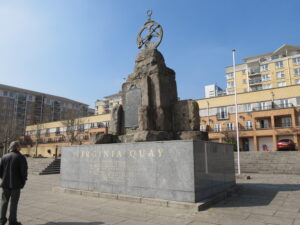
Royal Victoria Dock to East India Dock
Meeting point: Royal Victoria DLR station
If these docks could talk… Discover London’s only lighthouse, the settlers’ monument and the former home to the famous East India Company. And that only scratches the surface. This walk only takes place occasionally, but we also offer it as a private tour.
Take a walk on the waterside with us
London’s waterways and towpaths tell different tales from its roads and rails. Weave your way along their banks and discover London from an alternative viewpoint.
Our canal walks are created in conjunction with the IWA (Inland Waterways Association). You’ll be guided by someone with unparalleled knowledge of the route and its stories. There’s nothing like it.
Join us on the best London canal walks and discover their stories.

Pippa Jackson
Pippa is a word nerd and content aficionado with a background of working in TV on both sides of the globe. She loves to discover and share the diverse and wonderful stories of her much-loved London. When she’s not writing blogs and articles, you’ll find her walking beside the Thames or even paddleboarding on it (in the finest of conditions only!) or enjoying a coffee in the sunshine with a good book.

David Tucker
David – the Seigneur of this favoured realm – broods over words, breeds enthusiasms and is “unmanageable.”* He’s a balterer, literary historian, university lecturer, journalist, logophile and lifelong thanatophobe. For good measure, he’s the doyen of London guides.