
There were women in medicine long before universities admitted them. Women were herbalists, apothecaries and even physicians in the middle ages. But until the late 1800s the profession was barred to them – they were told they weren’t smart enough or robust enough to be doctors. They were lied to, assaulted and ridiculed. But they didn’t give up. It was pioneering women, supportive men and a building near the Euston road in London that opened the doors for women to join the ranks of male doctors in Britain.
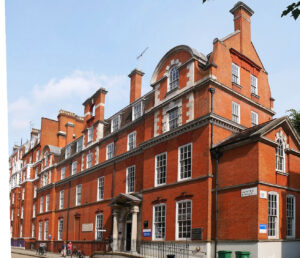
Former London School of Medicine for Women – where the door to the profession finally opened. (Credit: No Swan So Fine, Creative Commons Attribution-Share Alike 4.0 International)
This building – the groundbreaking London School of Medicine for Women was set up in 1874 by the first trailblazing women doctors – Sophie Jex-Blake, Elizabeth Blackwell and Elizabeth Garrett Anderson. In 1881 Britain had 25 women doctors – by 1911 there were nearly 500.
Walking around leafy Bloomsbury into fashionable Fitzrovia we see where some of these first women doctors lived and worked. Some staffed the New Hospital for Women on the Euston road, others became medical missionaries and travelled the world. These women doctors became a series of firsts: Louisa Garrett Anderson (daughter of Elizabeth) – who set up the first and only military hospital in the first world war in London run by women and Mildred Creake, the first female child psychiatrist and consultant at Great Ormond Street.
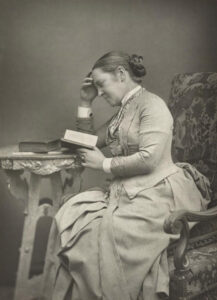
Elizabeth Garrett Anderson – the woman who broke the medical glass ceiling. Credit: Wellcome Library, London.
These women were often not only doctors but social reformers seeking equality for all women. Elizabeth Garrett Anderson signed the first petition to parliament for women to have the vote.
We will meet Octavia Wilberforce, a relation of the leader of the movement to abolish the slave trade who became Virginia Woolf’s doctor.
And we will discover Rukhmabai, a child bride who set up hospitals in India.
No walking tour about medical women would be complete without hearing about James Barry – a military surgeon who was not what he seemed.
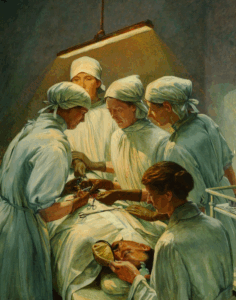
Trailblazers at work – women surgeons performing an operation at Endell Street Military Hospital, Covent Garden, 1915-1919. Credit: Wellcome Collection via Wikimedia Commons
IT ALL COMES DOWN TO THE GUIDING
PRACTICALS
The tour takes two hours and ends near Warren Street Underground Station.
And if you would like a recommendation: Friends House is the most civilised meeting point in that part of London. It has a lovely garden. It has a delightful cafe. Comfortable seating. Loos. Kind, thoughtful staff. And Friends House plants trees. What’s not to like. Our recommendation would be to get there a bit early, have a coffee and sit-down, and take some satisfaction in having found the best venue in the Euston area for a rendezvous, a coffee, or just to knit up the ravelled sleeve of care.
Ruth McCann –
For me now a trip to London would be incomplete without a Luisa led walk. This was my second and like the first, ‘Death, Debauchery and Doctors in Soho’, I found it so informative, educational, entertaining and thought provoking leaving me with a thirst to learn more. I am already planning my next trip around Luisa’s walks. I thoroughly recommend. Wear layers, a windcheater with a hood advisable.