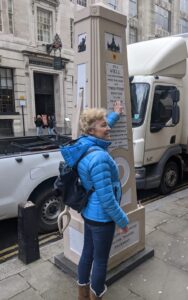
Lisa Honan CBE* is the distinguished former diplomat who guides our East India Company Walk.
Lisa’s got a past.
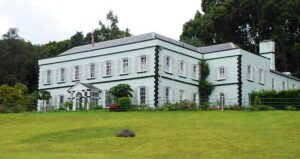
A former Governor of St Helena – a British Overseas Territory governed by the East India Company for 200 years – Lisa has a unique insight into the East India Company. Indeed she lived in the mansion – pictured below – that was built for East India Company Governors on St Helena in 1792.
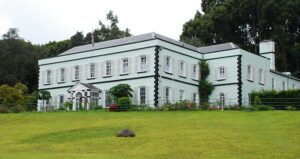
Plantation House, St Helena. The Governor’s official residence, and Lisa Honan CBE’s home during her time as Governor of the island.
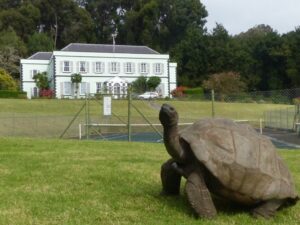
And as long as were at it, here’s Jonathan, the world’s oldest land animal, in Lisa’s front garden. She used to feed him. Jonathan pitched up not all that long after Napoleon checked out.
For the record, Lisa was the first woman Governor in its 500 years of history and so far the only one.
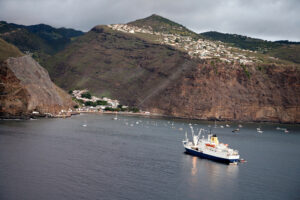
Having fed Jonathan, it’s time to stroll out to the palisades of St Helena to take a look out across the bay to Lisa’s (the Governor’s) ship, the RMS St Helena. It carried Governor Lisa and other passengers to and from St Helena. A six-day journey from Cape Town.
Ok, Governor Lisa having presented her diplomatic credentials, let’s get down to business with the walk. The former diplomat takes us to sites (sights and insights aplenty) associated with the East India Company. She lays bare its history, from 1600 to the present day.

She takes us to the courtyard where the Company first began in the 17th century. From there it’s a journey through East India Company history. How it changed what the world ate, drank, and wore through its trade with India, Indonesia, China and points beyond.
How it ruled over 300 million people in India. The battles it fought – some of them – with its private army. How it caused the Boston Tea party and sparked the desire for American independence. And there’s the file past of its people, its employees, variously called merchants, adventurers, pirates, traders, drug smugglers, and imperialists.

You go on this walk, matters of world-historical importance brush you with their wings. The East India Company wasn’t just the largest and most powerful multinational corporation in the world – it was history’s fulcrum.
And in the interests of making sure that nobody gets the wrong end of the stick: our view of the East India Company – and indeed Lisa’s view – is trenchantly summed up by John O’Farrell’s observation that it was “a sustained protection racket that went on for nearly 300 years and needed military brutality to enforce it.” And that generally British colonialism and imperialism “required and therefore cultivated a level of racism from which we have still not recovered.”