
From the Rep Walks
Additional Information Anyone?

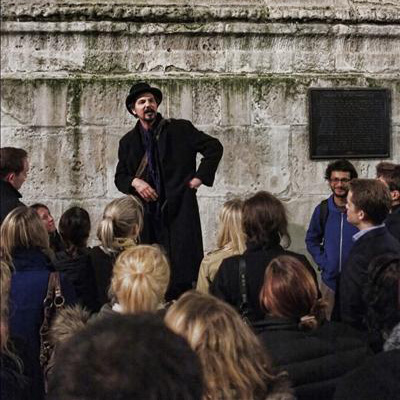
User's Directions: This "page" is a two-parter. First, some prefatory, explanatory notes. Further down you get the "blurbs" for lots of our From the Repertory and Special Walks. What I'm saying is, if you want to go straight to the "blurbs" you have to scroll down past these introductory remarks.The photo of Mike and a group of walkers on a Beachcombing Walk is the "bridge" between the two halves.

We get a ton of requests for "additional information" about the From the Repertory Walks. Haven't been able to meet that request on the leaflet because there are over 300 different walks in the full London Walks repertory and there's only so much room on a piece of paper and the document already runs to 21,000 words. Well, you'll get my drift...

But cyber-space "bends" space. It's elastic. You can stretch it. So here on the website at any rate we can meet that request. And we're doing so. We got this particular ball rolling just over a year ao. And have made a good start on it - as you'll see if you scroll down. But there's still more to come - so please do be patient - it's going to take a longish while to get the full complement up here. Not least because there are over 300 different London Walks. In short, it's not all down to my innate dilatoriness!

And the other thing to stress here is that these entries are very much in the way of "additional information". Each of them is a "blurb" about a given From the Repertory or Special Walk. Initially we were also "inputting" here the dates that any given From the Repertory or Special Walk would take place. We've rethought that "strategy" though - simply because it was so time consuming to stay on top of those dates...putting them in, taking them out when they'd been and gone, etc. etc. And if one got away from us - well, it was problematic, to say the least. Simply because the date referred to may have been from a previous year - a walk that was, well, "history". In short, there was a danger of people getting the wrong end of the stick.
So we've simplified. No dates here, just "background information". For the dates of any given From the Repertory or Special Walk you need to go to those sections - they're laid our as "tables", so you can scroll down through them very quickly. And if you find one there that you'd like to know more about - and if there is a "blurb" for it - well, double click on the link and that will take you to the entry here in this section.

Oh and I suppose the other thing to mention here is that any of these From the Repertory or Special Walks can be done as a private walk. So we thought this "set of rooms" on the website might be useful for "group leaders", teachers, etc. who were interested in "further reading" - i.e., finding out more about the full range of the London Walks programme - with a view perhaps to booking one of our more exotic "blooms" for a private walk.

And just one or two other bits and bobs...

John has done a heroic - a sterling (now there's a word that's brilliantly rooted in London history, as those of you who have been on my Along the Thames Pub Walk know) - job of chasing down the guides, shaking some "blurb dust" out of them, and shaping and baking it into tasty and helpful "brownie blurbs".

And I think you'll like the "add-ons" John's come up with. Namely where each of the From the Repertory walks ends - the closest Tube Stop - and a "Latecomers Catch-up Point". Can't be bad.

And now it's down to me, David, to keep on tweak'en 'em and getten' 'em up onto this page.

Which I've been plugging away at for a good few months now - and will be doing for a good few more. To start with I was trying to roll them out as they hoved into view. But in the end I switched over to listing them alphabetically. As you'll see, so far there are about 30 of them up here and strutting their stuff.

But that's enough foreplay. Let the parade begin...

Mike W. and Walkers "Beachcombing" on the Thames


500 Years of Black London
Add to "Basket"

Black Londoners - famous lives: politicos and writers, servants and masters, wits and wenches, freaks and curios, haunts and habits...we'll be looking back at the first traces of the black presence in London and the continuing themes it evoked.

There was a growing black presence in London as far back as Tudor times (1485-1603) right the way through to the 1950s, when the post war labour shortage tempted thousands to come over from the West Indies, on to vibrant present day multi-cultural London where the black community plays an ever more vital role in the life the capital.

To go on the 500 Years of Black London Walk
meet Steve M. just outside
exit 4 of WestminsterTube.

The "Late Comers Catch-up Stop" is King Charles Street, Whitehall.
 
The walk will end near Covent GardenTube.

Walkers recommendations
Write your recommendation

ALL CHANGE AT ST. PANCRAS*

“We’ll give London Walks access to parts of the station
that aren’t open to the public.”**

Well, we weren’t going to say no to that offer, were we! Weren’t going to say no to it because: “St. Pancras is the most significant urban structure built by the railways. Both its engine shed, the inelegant name given to the
enormous glass and iron shelter over the platforms… and the Gilbert Scott hotel would be notable individually, but together they create a world-class terminus… The sheer scale is breathtaking in itself as the station is 150
metres wide and twice that distance long, but the Gothic design, with its exaggerated features such as the clock tower, numerous spires and the large statue of Britannia glaring over at King’s Cross make it one of London’s greatest landmarks” (from Fire & Steam by Christian Wolmar). And that’s just the centrepiece! There’s also the oldest church in Christendom Britain (and its extraordinary churchyard), a stunning roof-top view, and “the mind and memory of the nation!”

*Bottom line: this is the most significant new walk to be added to the London Walks repertory in the last 25 years! 

**We couldn't get specific about this one - had to hold back wth this blurb - because some of these particulars were still in the "development stage" those first couple of months after the station opened. But it looks like the "access" spun gold is coming together now. I.E., we think - we hope - we'll be good to go on that particular count from here on out. Drop us a line - or give us a bell - or indeed check back here in due course and we'll let you know for sure.

And there's no reason to be coy about the genesis of this walk. The plain fact of the matter is St. Pancras has really pulled out the stops for us - including being shown round the redevelopment by the architect himself! As you know, we set a lot by "insider information" and "local knowledge" - and it doesn't get much more "insider" and "local" than a private tour given by the man who spent nine years bringing the project to fruition! And embarrass des riches, the next couple of ones we're going to do are timed to "feed into" at walk's end a lecture that Alastair, the architect, is going to give there at the station. And - for the proverbial cherry on top of the Sunday sundaes, these next two walks will be guided by Steve, who's an architect himself (he does the Frozen Music - the City of London and West End architecure - walks that come up occasionally in our From the Repertory slots.

Guided by Tom, Brian, Richard III or Steve.

To go on the All Change at St. Pancras Walk meet the guide just outside the Euston Road north exit of King’s CrossTube.

King's CrossTube is on the Circle, Metropolitan, Northern, Victoria & Piccadilly Lines.


Amazing Grace

A Walk to Celebrate the Abolition of the Slave Trade

Comes the anniversary comes the walk!

And pace Winston Churchill...this may have been London's finest hour!

Their names ring down the centuries, the great and the good who fought for freedom: Wilberforce, Wedgewood, Wesley, Blake, John Newton, Cowper. And that's not to forget the lesser known who began the cause: Granville Sharp, Thomas Clarkson, James Phillips and Oladouh Equiano.

Truly, here in the bosom of the City beat the heart of compassion, answering the slave's cry, "Am I not a man and a Brother?"

Amazing Grace indeed.

Anniversaries don't come any more important than this one. Which is why it's important to go and see where - to go over the ground, literally and figuratively -  to travel back...to bear witness.

The starting point for The Amazing Grace walk is MonumentTube.
Meet Jean just outside the Fish Street Hill exit.


The Amazing Old Shops Walk

Attention shopaholics! Get ready for some high class retail therapy. And where the prices are stratospheric...well we'll indulge in a peck of window shopping and a pack of what-might-have-been!  Credit cards at the ready...

Here's what's on our "shopping list": some of the oldest and most fascinating establishments, all decked out in their Christmas finery: shops which supplied the real Evita with perfume, the suffragettes with food hampers and the Duke of Wellington with books. Shopers where you can buy an Eton College boater, antique toy soldiers, the best selection of the finest cheeses, handmade shoes - and a great hangover cure!!!

The Amazing Old Shops Walk for last minute you know what!
 
normally takes place about a week before Christmas. It's often
the From the Rep Walk - either 10.45 am or 2.30 pm - on the
Saturday before Christmas.

To go on it meet Judy just outside Green ParkTube.

The "Latecomers Catch-up Stop" is
the corner of Old Bond Street and Burlington Gardens.

The walk ends near Green ParkTube.


The Backstairs Belgravia Pub Walk

London's drawing room. That's where we're headed. And first things first: There's no other neighbourhood in London like this. It looks different. Sounds different. Feels different. All pearly stucco and cut glass accents and blue blood...the place simply breathes money. The people who live here are people who could live anywhere. Which is why they live here. Here in this movie-set corner of London. Here in Upstairs-Downstairs land, so profoundly English, but also, somehow, exotic. And what a cavalcade of residents: Baroness Margaret Thatcher, David Niven, Vivien Leigh, Lord Lucan, Mozart, Andrew Lloyd Webber, Omar Shariff, and other rare plumages. After tonight you'll be able to do some world class name dropping! And because we're going to see it through the peep-hole - threading our way through its cobbled little lanes and mews - past secret escapes and vistas of sudden surprise - we'll make some wonderful discoveries. For good measure we'll call in at a couple of pubs that are small masterpieces - the haunts of those who know! (Food is available.) 

To go on The Backstairs Belgravia Pub Walk
meet just outside the exit of Sloane SquareTube.


Bauhaus to Our House -
Modernist Architecture in Olde NW3
 
Eighty years ago the German Bauhaus movement of art, design and architecture shook the world. From the designs of BMW to the shelves of IKEA, its influence is still very much with us. Hampstead - NW3 - has some of the most visually exciting Bauhaus buildings in the UK: the now sadly neglected Isokon building, Maxwell Fry's Sun House, and Erno Goldfinger's 1-3 Willow Road. Three indelible gems to reminds of the legacy of the school which was closed down in Berlin by the Nazis in 1933 and scattered its creative talents to the USA, Britain, and other countries.

The Bauhaus to Our House Walk is guided by the distinguished London Historian Ed Glinert, the author of London: Exploring the Hidden Metropolis, The London Compendium, and A Literary Guide to London.
 
To go on the Bauhaus to Our House Walk
meet Ed just outside Belsize ParkTube.

The "Latecomers Catch-up Stop" is at
the junction of Downside Crescent and Lawn Road.

The walk ends at HampsteadTube.


Bethnal Green - The Lost Village in Londn's Backyard
Originally a green and pleasant area attracting wealthy residents, by Victorian times the Bethnal Green district had become the poorest in London. The housing and sanitation were appalling. TB was rampant. Needless to say, the area was transformed following the Second World War bombing, subsequent slum clearance, and the rise of the big housing estates. All changed. Changed utterly. Or is it? Which is by way of saying, if you know where - and how - took (and Hilary certainly does) there are enough interesting hints and glimpses of the bad old days to take us back down the corridor of years. Let alone prompt some gob-smacking stories! In short, this one's very much of the beaten tourist track. It's Londoners" London. Which makes it a Snap! when you hear that it was here that Samuel Pepys stashed his dirary away during the Great Fire. Oh and another shining thread...children of all ages, including seniors, will delight in the Museum of Childhood.

To go on the Bethnal Green -
The Lost Village in London's Backyard walk
meet Hilary just outside the exit of Bethnal GreenTube.

The Latecomers Catch-up stop is in the park next to the station.

The Bethnal Green walk ends back at Bethnal GreenTube.


Betjeman on Boxing Day
 
It’s Boxing Day and the chance of being summoned by bells, not to attend church but to hear beautifully crafted verses from John Betjeman, Britain’s best-loved poet. Betjeman wrote with such affection about north London – about “Delaunay-Bellevilles crawling up West Hill in bottom gear”, about being “safe in a world of trains and buttered toast”, about Zwanziger the baker's, and the Bon Marché, and the terrace “blackish-brown, and the curious Anglo-Norman parish church of Kentish Town” – and we'll be following in the great man’s footsteps, to the places he wrote about, the houses he lived in, the churches he prayed in, the railway stations he dreamed in.

• Notice how the walk starts at Kentish Townstation, not for instance South Kentish Town station. That closed some time ago. It was also the setting for Betjeman’s great long-lost short story about a clerk who gets off the train when it stops by chance in the disused station after the doors accidentally open. It’s a wonderful ghost story, the perfect cure for that post-Christmas hang-over. Bit like this walk really. Guided by Ed
 

The Bloody City -
Rulers & Rebels in Mediaeval London
Take a walk through through the dark side of London’s history where anyone who practiced freedom of speech usually lived to regret it...

Follow in the footsteps of martyrs at a time of vicious persecutions; discover the fate of one king murdered for his religious beliefs and another killed on the orders of his wife.

Other highlights include one of London‘s churches which gained a reputation of bad luck for anyone who tried to shelter in it, the site where the Gunpowder plotters met; where the City backed the rebellion against a king; where a discredited nobleman led an army against his queen.
 
And, hey, this year, 2007, there's even the frisson of an appropriate anniversary - the walk will take place on the anniversary of Bloody Mary’s death. Needless to say, we'll see the gatehouse where legend has it she sat knocking back the wine and feasting on roast chicken while watching Protestant martyrs being burned alive outside. 
 
And another "frisson": the walk's been created and will be guided by an award-winning Blue Badge Guide who, into the bargain, can read Egyptian hieroglyphics!  Her name's Vicky.
 
The Bloody City - Rulers & Rebels in Mediaeval London is the 10.45 am From the Repertory walk for Saturday, 17 November 2007. To go on it meet Vicky just outside the exit of BarbicanTube.
 

Charles Dickens's Christmas Carol & Seasonal Traditions
All the delights and delicacies of a London Victorian Christmas with Charles Dickens's famous story The Christmas Carol as your route map and inspiration. We'll deck the streets of London with balls of jolly. Scrooge and Marley and the Cratchits...they're all here. This was where Dickens's imagination took wing and where the characters did their thing. And as we make their acquaintance we'll spice things with warming seasonal stories of turkeys and boars" heads, Christmas puds, mince pies and pantomimes; cards, crackers, Christmas trees and mistletoe. Let alone the bells that rang out on Christmas morning to wake Scrooge up - a much changed character. HAPPY CHRISTMAS EVERYBODY!

Charles Dickens's Christmas Carol & Seasonal Traditions
makes several appearance in the From the Repertory programme
from late November onwards. Watch this space!

To go on the Charles Dickens's Christmas Carol & Seasonal Traditions walk
meet June just outside the exit of Tower HillTube at the appointed hour and date.

The "Latecomers Catch-up Stop" is by the Roman Wall in Cooper's Row.

The walk ends near St. Paul'sTube.


The Christmas Cockney London Walk
You've probably just about recovered from the Christmas blow out festivities - now's the chance to gently walk it off, and at the same time, learn about a Cockney Christmas past.  And if we're lucky enough to have a white Christmas, the old City of London will be the perfect Christmas card setting for this walk through 800 years of history including the Black Death, the Second World War blitz and the rise and rise of the modern rebuilt parts of the City.  And unlike HM The Queen, you don't have to ask the Lord Mayor's permission to enter it!
 
It's the working haunt of rich businessmen and bankers but it's also a favourite with all types of Londoners, including of course, the Cockneys - especially the 'Pearlies'.  There's plenty to interest Londoners and tourists alike; plenty to take a good 'butcher's hook'  (look!) at.

Your host and genial guide for this morning's walk, our very own Londoner par excellence, Jean, will be decked out in her Cockney 'glad rags' - her splendid Pearly Queen costume.  With stories and snatches of popular songs from the nostalgic age of the Victorian and Edwardian Music Halls, she'll be telling you the colourful story of London and its inhabitants.  You'll be welcome to sing-along-a-Jean if you want to, and if the festive mood really grabs you, a little gentle knees up Mother Brown would go down a bundle too!
 
We think it's the best city in the world.  By the time Jean says Goodbye and a cheery Happy New Year to you all, we hope you do too!.  

To go on the Christmas Cockney London walk
meet just outside exit 2 of St. Paul'sTube.

The Latecomers Catch-up Stop is St. Mary-le-Bow,
which is about a hundred yards along Cheapside, on the right.

The walk ends back at St. Paul's.


Detectives' London
Naturally Miss Marple is on the case today and in neat no nonsense costume for the occasion. For crime and private eye fans this walk repays a little gentle investigation...The Ladykillers, a host of female detective story writers and their immortal character creations. Murder most elegant for those of a fine mind; slaughter in St. James's for the rest of us.
To go sleuthing with Miss Marple (aka Jean) meet her just outside the north exit of Green ParkTube.

The Latcomers Catch-up point is on the north side of Piccadilly, just across the way from the Ritz hotel.

This is one of our circular walks - i.e., it'll end back at Green Park
Tube.


Dial M for Murder
 
      “You are 14-years-old. You walk down the Charing Cross Road. You are accosted by a man wearing a flashy tie. The rest follows on from there.” So explained Frank Norman, the Barnardo’s boy who became an unlikely celebrity after writing his prison memoirs.

       This is the world the West End villain enters, one of dazzle, glitter, glitz, glamour. But there’s also a dark side. Occasionally things get out of hand. Someone dials “M”. On the other end of the line is a representative of Murder Incorporated. Soho is that kind of place, or at least it was. Or as Scotland Yard’s Ted Greeno put it, “in the West End you could buy anything and see everything; and you could get your throat slit more promptly than in a pirate ship on the China Seas”.

        Don’t worry. It was all long ago. Murder Incorporated has closed down, and its directors are now so much dust, but the fascination for their stories remains. And what stories. Like how Soho’s Jewish and Italian gangsters fought like tigers during the Second World War, culminating in the fatal stabbing in 1941 of Harry “Little Hubby” Distleman, doorman of the West End Bridge and Billiards club. Like the tale of how the owner of a deli on Old Compton Street planned the assassination of none other than Benito Mussolini – Il Duce himself – in Rome (all this from Soho) and nearly got his way.

     Make an appointment to Dial M for Murder on Saturday 15 December (2007). Meet the guide, the distinguished London historian Ed Glinert, at 2.30pm outside Oxford Circustube (Exit 6). Probably just as well though if you don't tell Jack Spot, Darby Sabini, Reggie Kray, Billy Hill, Jack the Stripper or Moishe Blueball that you're swanning around "sight seeing" on their patch!


The Edward Petherbridge Theatreland Walk

As one American lady put it, "my Gawd, it's like being shown around Manhattan by Dustin Hoffman." To which Edward - in his inimitable, dryly witty way - responded, "Dustin would be glad to know he's got that to fall back on to."

But seriously, it's a real treat this one. Edward Petherbridge is one of the great classical stage actors of our time - and it's tough to beat a wee stroll through his patch - theatreland - with him for a couple of hours of a Sunday morning (or very occasionally, of a Sunday afternoon). People fork out 40 quid to get a stalls seat to watch him in a West End show and here you can be at his elbow and indeed shoot the breeze with him for six quid. Or a fiver for concs. Forget hanging around outside the stage door in hopes of getting an autograph. That's for chumps. The real deal is to go on his walk. It's like joining Edward - and chilling - in the green room. Or like being shown around Manhattan by Dustin Hoffman!


"England Expects - The London of Admiral Nelson

This one's soaked in memories - and haunted by ghosts...

Who would have thought that, on this walk we should, so often, encounter the "Nelson Touch"?  Indoors and out we find memories of "The Hero",as he was simply known, from monuments to portraits, his homes  - with Lady Nelson or "Dearest Emma" - the Admiralty, the Navy Board, to his final resting-place in the heart of the City.

N.B., this is one of our "anniversary walks" - i.e., we try to run it on (or right around the time of) Trafalgar Day!

The starting point for the "England Expects" - The London of Admiral Nelson Walk is just outside the Ritz exit of Green ParkTube.

The Latecomers Catch-up Stop is in St. James Street.


Foodies' West End
 
What did Oscar Wilde have for lunch? Who bought their beef tea at Fortnums? Which king took a roast chicken to bed for a night time snack( and that's after 11 courses at dinner). For the answer to these and many other foodie questions - and for a visit to a street market and a foodie look at Chinatown, join Ann's walk looking at how Londoners dined down town in the 19th, 20th and 21st centuries.
February 23, 2pm at Green Park tube, Ritz exit (of course - what gourmet dish was invented at the Ritz? Come and find out).
 

Gangs of the East End
In USA say gangster...think Al Capone and Chicago.

In UK say gangster...think Kray Brothers and London's East End.
 
The three Kray brothers - twins Ronnie and Reggie and older brother Charlie - were the most infamous gangsters this side of the Atlantic since World War II. In the 1950s and 1960s London was awash with prostitution, gambling, fraud and protection rackets. There was serious money to be made and some very unsavoury characters - and the gangs they were associated with - got their snouts into the trough, big time. They had their own turf - their own "exclusive" territories (manors in their argot) - and the Kray brothers ruled the East End with razor-edged violence right-the-way through to murder.
 
So, step this way, ladies and gentlemen. Let's walk some of the meanest streets in London...byways where the knives of the Krays once glinted and many a villain passerby sported tell-tale scars between prominent cauliflower ears.
 
To go on The Gangs of the East End - Krays & Capers, Diamond Geezers & the Profession of Violence Walk meet Ed Glinert - the distinguished London historian - just outside ShoreditchTube.

For the Latecomers Catch-up Stop go north up Brick Lane into Back Street and then to St. Matthews Church.
 
The walk ends near WhitechapelTube.


George Orwell's London
War is Peace; Freedom is Slavery...

Guided in the compelling spirit of 1984 this walk is through London's "West End" where Orwell worked, drank and gained inspiration. It's a rich repast - everything from the church which inspired the Ministry of Love in 1984 and Keep the Aspidistra Flying to the skyscraper which provided the model for the Ministry of Truth. And that's just the Orwell! Which is by way of saying, Ed's spiced the thing with a ton of accompanying material...in the shape of non-Orwellian dubious but intriguing outriders and delights!

The George Orwell's London Walk is guided by the distinguished London historian, Ed Glinert, the author of London: Exploring the Hidden Metropolis, The London Compendium, and A Literary Guide to London.

To go on the George Orwell's London Walk meet Ed
just outside exit 6 of Oxford Circus
Tube.

The walk ends near Russell SquareTube.


Gracious, Gorgeous, Georgian Canonbury - The Pub Walk

Think of the oldest buildings in the capital: the Tower of London; Westminster Abbey (parts of, anyway); Temple Church, Guildhall…No one ever thinks of Canonbury Tower. Very few ever see it, unless they live in the area, and even then it’s not easy to spot. Less than 5 minutes walk from busy Highbury & Islington station, which tens of thousands use a day, is this ancient, bizarre and lofty structure. It truly is an astonishing sight to see a squat brick building evidently dating back to the early 16th century built so high. They didn’t do towers in those days. Yet Canonbury has Roman origins and was rebuilt in 1373 as well as 1520 and several times since. Why a tower? Prior Bolton, who was in charge of the place, had received astrological warnings of an imminent flood, so he built up and up. If it fell down, at least he would be dry in the meantime. He stocked it with food to last two months, but the flood never came.

Another reason for Canonbury Tower’s anonymity is that it’s not exactly open to the public. It is used as a research centre by the Freemasons. And that’s only one of the strange things connected with the place. It used to be the home of Francis Bacon, the 17th century Lord Chancellor and creator of the modern day notion of “science”. Some literary experts believe he may have written the plays attributed to his contemporary, one William Shakespeare. The Bard’s works allegedly containing cryptograms that suggest Bacon was the author. Bacon is also said to be the founder of modern English Freemasonry and was its first Grand Master.
In the 18th century the estate around the tower was built with the most elegant Palladian architecture. This new estate was given the exact dimensions of Solomon’s Temple – the outbuildings, the walls, the proportions…an exact replica. That’s a bit strange. It’s not the kind of thing that happens in the typical London synagogue, for instance.

Inside the Tower are grandiosely decorated rooms featuring much wood panelling. Behind one section lies a bricked up passage sealed up in the 1940s “because of the bad air”, as the caretaker told a group of American tourists. The passage leads to a tunnel which is believed to be connected to St Bartholomew’s Hospital (Bart’s) nearly two miles south.

Oh, I’m spoiling it all now. You’ll have to turn up to find out more. We’re meeting outside Highbury & Islington tube at 7.15 and will be visiting some cracking pubs en route so that at least you’ll be fuelled up if we get to sample that bad air or those dank tunnels.

Editor's note: yes, this one's another Ed Glinert "special".


Harrow on the Hill - Views & Vistas, Byron & Bygones
 
Say the words Harrow on the Hill and ask people to free associate and likely as not you'll get the following three gorgeous plumages coming into view: the HILL, the young WINSTON, and the famous SCHOOL. Those are rich pickings...a lot of time past and history to catch up on. So just to throw down some markers for you...the 12th-century church of St. Mary dominates - and graces - the area. Location, location, location...yes, it's perched high on Harrow Hill. The great event in Harrow's history was the founding of Harrow School in 1572. Winston Churchill and other British Prime Ministers were educated here. As were Lord Byron and untold legions of noblemen. And hats off as well to its mixture of tones. In short, the highlights are only part of the story. Which is by way of saying, Harrow's also an attractive, unspoilt, literary village - it was home to Matthew Arnold and Anthony Trollope - complete with village green and even a Court of Pie Powder!
 
To go on the Harrow on the Hill walk meet Sue just outside the Marylebone Road exit of Baker StreetTube.
 
To get to the "Latecomers Catch-up Stop" take the lowland exit out of Harrow on the Hill  Railway Station, walk to Harrow Road,
cross to the green and turn left.
 
The walk ends at Harrow on the Hill  Railway Station.

Hell's Kitchen - Murder, Mystics, Mayhem & Mosley
The shirts were black not brown. And - thank goodness - the outcome was different. But in other respects...well, welcome to the cauldron - to the sump. This was where Fascism strutted its stuff in London in the 1930s. Demogoguery and depression, anti-semitism and agitation, social tensions and pseudospeciation...it was the same witches' brew that was swirling through the nascent Third Reich. In the East End of London it came to a head in 1936. Mosley's Fascist black shirts decided to march through Cable Street come what may. Left wingers and local people manned the barricades to stop them. Serious fighting broke out. It was a tiny, terrible foretaste of what was to come. In short, it's hardly an exaggeration to say that the Battle of Cable street was the English-speaking people's first foray into the valley of the shadow of death that convulsed the world in the months and years ahead.
 
In short, this is another one of those London neighbourhoods where the "sense of place" is redolent of the past. And make no mistake the texture here isn't just 1930s newsreel. The Ratcliffe Highway Murders, riots at St. George's church, the custom of opium smoking in Shadwell, wave after wave of immigration...are all part of the warp and woof of London's Hell's Kitchen.
 
To go on the Hell's Kitchen - Murder, Mystics, Mayhem & Mosley walk meet Ed just outside the exit of Tower HillTube. 
 
The "Latecomers Catch-up Stop" is at St. Katherine's Dock,
just downstream from Tower Bridge.
 
The walk ends at Shadwell Station, which is on the Docklands Light Railway.


Hie to High Barnet

Jean takes us to the top of that Cresta Run that swoops down to London Town - but, unlike Dick Whittington , we will not 'turn again' to the City, but to Chipping Barnet - the Market town - Barnet Fair, notorious Costermongers' Carnival;  Barnet's Battle, where the King of the White Rose overcame the Kingmaker of the Red; Barnet's Benevolence - almshouses for 'ancient women' so they be not "beggars, drunkards, backbiters,talebearers, scolds, thieves or witches". And not forgetting Boozy Barnet, another sobriquet that High Barnet acquired on its rollicking, roiling, royal way!

The Hie to High Barnet Walk starts at High BarnetTube.

The Latecomers Catch-up Stop  is up the hill, by the Red Lion Pub.

The Hie to High Barnet Walk ends back at High BarnetTube.


Historic Barnes
Barnes. Ah, Barnes. It'll steal your heart away. It's very much a down-by-the-river kinda place. A leafy countryside beauty kinda place. A charming village kinda place. You go there you've opened a magic casement on a different time and place...and the wonder of it of course - well, one of the wonders - is that you're still in London.
 
But let's narrow the focus. One of the walk's highlights is the house where Gustav Holst composed 'The Planets'...and from Planet suite to planet sweet - well, planet present day world. Which is by way of saying, along the way you get an ecologist's expert view on this most picturesque but fragile part of the planet during a visit to the area's wonderful Wetlands Centre.
 
To go on the Historic Barnes walk meet Janet at Waterloo Railway Station (we'll be going to Barnes Bridge  Station so we'll meet up by Platform 16 of Waterloo  Railway Station).
 
The "Latecomers Catchup Stop" is along the the riverside by the Thames...just by Barnes Bridge Station.
 

Into the Twilight Zone
Ley Lines, Lenin, Mystics and the Occult in the Unreal City
 
The nearest staging post to old London on the Great North Road, the Angel was an especially welcome stopover place for travellers at night when fields towards the City were dangerous and warranted armed patrols. And if you know where to go and what to look for...that "vibe" is still detectable. And there's an equally disturbing minor key here. Not to put too fine a point on it, the area's landscape and street names have occult resonances. So if you like your London weird...well, wizards, mystics, pagan sites, the imaginary birthplace of Frankenstein and the terminus for Hogwarts all feature in this spooky cocktail shaker of a walk.
 
The Into the Twilight Zone walk starts at AngelTube.

The Latecomers Catch-up Stop is in Pentonville Road.
 
The walk ends at King's CrossTube.


Jane Austen's London
Add to "Basket"
 
With your guide Janet suitably and impeccably dressed for the occasion as Jane Austen herself, walk daintily in the footsteps of the famous author who visited London as a young woman from her parish home in Hampshire. It's all "Sense and Sensibility". Not least because it takes in the area in which she set her London house parties in the famous novel. Some say her life was "notable" for its lack of events. Don't you believe it for a second. This after all was the lady who dropped her "Pride and Prejudice" at the invitation of a Prince (Regent). Ms. Austen - what would she have made of that linguistic fig leaf? - attended the beautiful St. James Piccadilly church...and you will too. For the record, it's the only one of Wren's London churches to be built on an entirely new site and it became the prototype for most 18th-century urban churches.

To explore Jane Austen's London meet Jane -
Janet, I mean - on the corner just outside
the north exit of Green ParkTube.

The "Latecomers Catch-up Stop" is in Mayfair Place.

The walk ends near Covent GardenTube.

Walkers recommendations
Write your recommendation

Karl Marx in London
Walkers of the World Unite!

MAY DAY and MARX! Forward comrades! Through the barriers and into the barrios (of the past)...thanks to the stories and many of the Marx sites (and sights!) in London, ending at the magnificent British Museum Reading Room where the great man wrote the world shaking Das Kapital. So where are we? And when? Well, Soho and Bloomsbury a century and more ago. Marx came to live in London's Soho in 1849; he died in 1883.
 
Today saucy Soho is best known for its sex industry. Not too many punters strollings its pavements are aware - or care - about its unique place in the history of political and revolutionary thought.
 
The walk takes in the place where he was asked to write the Communist Manifesto in 1850; the site of the German-owned hotel where he was thrown out for not paying the rent. Then on though chinatown to Dean Street where the Marx family lived for six years in what he described as "bourgeois misery"...many times reduced to living on bread and potatoes.
 
It was here in London that Marx found - in the the words of a leading German Socialist - what he was looking for: the "bricks and mortar" for his ideas in Das Kapital, which some say could only have been written in the London of his time. A time of booming raw capitalism which promoted the accumulation of great wealth - but into the bargain, the abject misery and poverty of the workers.
 
Mind you, that other great Soho denizen - the London poet and visionary artist William Blake - got there first...and managed to light up that particular landscape - the corruption of inequality -in a way that didn't lead to the deaths of millions.
 
                                          Pity would be no more,
                                          If we did not make somebody Poor...
 
To go on the Karl Marx in London - Walkers of the World Unite! walk meet just outside the Subway 1 exit of Piccadilly CircusTube.
 
"The "Latecomers Catch-up Stops are: Glasshouse & Sherwood Street


Limehouse & Old China Town -
Mysteries of the Orient

The Mysteries of the Orient in London's dockland; the ghostly lit mean streets; the opium dens and the damp causeway that slinks its way from West India Dock Road to the dark dank waters beyond.

London's Chinese community first settled here in the 18th-century. And if that sounds ho-hum think again, ladies and gentlemen. Because we're talking about a colony of sailors who built up Chinatown and ran the exotic legendary opium and gambling dens for their compatriots. Consider the street names: Ming Street, Canton Street, Pekin Street, Nankin Street. What's in a name? Well, hold onto your hats folks because London doesn't get any more exotic than this.

To go on the Limehouse & Old China Town walk meet your guide - Ed Glinert, the distinguished London historian (he's the author of London: Exploring the Hidden Metropolis, The London Compendium, and A Literary Guide to London) - just outside the main exit (NOT the Bank Street exit) of Canary WharfTube.

There's no "Latercomers Catch-up Stop" on this one...because if you're late we're going to be well nigh impossible to find!

The walk ends near Limehouse station. It's part of the Docklands Light Railway (DLR) system, which, if you think about it, makes for an almost dizzying transformation: from 18th-century opium dens to cutting edge 21st-century London. The DLR is a completely automated, elevated whoosh - with lots of Wow! factor - through the largest urban redevelopment in Europe. And if you've got a 2-Zone Travel Card, well it's a "ticket to ride" on the DLR.


The London by Gaslight Pub Walk

Palaces & Pubs; Gaslit Lanes & Theatreland;
Phantoms & Flashbulb Moments*

This is a great pub walk. It's vintage London, vortex London. It's "downtown" at its best. It's 18th-century gas-lit lanes and an ancient square and the oldest theatre in London. It's tucked-away, much-loved - and very old - pubs. It's where Londoners come to play. It's where visitors searching for the holy grail of Newsweek's "coolest city on earth" come closest to finding it. It's where high spirits and history rhyme. It's where the heart of this great city beats. It's where, more than anywhere else, you're going to feel London in your veins. (Food is available.) Guided by Richard III or Fiona.
*E.G., raising a glass - which we'll do - with the orchestra of the Royal Opera House!
 

The meeting point for The London by Gaslight Pub Walk is just outside the exit of EmbankmentTube.

EmbankmentTube is on
theCircle
, Bakerloo, District & Northern Lines


The Lord Mayor's Day Cockney London Walk
            
It's the City of London's biggest day of the year.  The new Lord Mayor has been sworn in at the Royal Courts of Justice; the pageantry of the big parade is over for yet another year - the 783rd!  Londoners are ready to let their hair down and enjoy themselves.
 
The new Lord Mayor is not the only diamond geezer all decked out in his finery. Jean, your very own guide, is all pearled up for the occasion in her traditional Pearly Queen ensemble, ready to give you the highlights, lowlights and insights on the colourful history of London's citizens - Cockneys included! - in story and in song.
 
Join in some of the old favourite Music Hall choruses of yesteryear - sing-along-a-while-with Jean, and if the fancy really takes you, try a little gentle knees up even! Work up a thirst - and quench it with a nice cuppa Rosie Lee. You'll then be well fortified for the big day's grand finale - a good 'butcher's hook'  (look!) at the spectacular fireworks fired from a barge in the middle of Old Father Thames. 

The Lord Mayor's Day Cockney London Walk is usually the 2:30 pm From the Repertory offering on the second Saturday in November, which is Lord Mayor's Day.

To go on it this year, 2007, meet Jean at 2:30 pm
just outside exit 2 of St. Paul'sTube.

The "Latecomers Catch-up stop is St. Mary Le Bow Church,
which is about a hundred along Cheapside, on the right.

The walk ends back at St. Paul'sTube.

St. Paul'sTube is on the Central Line


Mediaeval London
 
"When the world [and London] were half a thousand years younger
all events had much sharper outlines than now.
 
"The distance between sadness and joy, between good and bad fortune, seemed to be much greater than for us; every experience had that degree of directness and absoluteness that joy and sadness still have in the mind of a child....There was less relief available for misfortune and for sickness; they came in a more fearful and more painful way. Sickeness contrasted more strongly with health. The cutting cold and the dreaded darkness of winter were more concrete evils. Honour and wealth were enjoyed more fervently and greedily because they contrasted still more than now with lamentable poverty. A fur-lined robe of office, a bright fire in the oven, drink and jest, and a soft bed possessed a high value for enjoyment that would be inconceivable in the 21st century.

"All things in life had about them something glitteringly and cruelly public. The lepers, shaking their rattles and holding processions, put their deformities openly on display. Every estate, order, and craft could be recognized by its dress. The notables, never appearing without the ostentatious display of their weapons and liveried
servants, inspired awe and envy. The administration of justice, the sales of goods, weddings and funerals--all announced themselves through processions, shouts, lamentations and music. The lover carried the emblem of his lady, the member the insignia of his fraternity, the party the colours and coat of arms of its lord.
 
"In their external appearance, too, town and countryside displayed the same contrast and colour. The city did not dissipate, as do our cities, into carelessly fashioned, ugly factories [and shopping malls] and monotonous country homes, but, enclosed by its walls, presented a completely rounded picture that included its innumerable protruding towers. No matter how high and weighty the stone houses of the noblemen or merchants may have been churches with their proudly rising masses of stone, dominated the city silhouettes.
 
"Just as the contrast between summer and winter was stronger than in our present lives, so was the difference between light and dark, quiet and noise. The modern city hardly knows pure darkness or true silence anymore, nor does it know the effect of a single small light or that of a lonely distant shout."
 
Okay, that's enough mood music. Here's some nuts and bolts. This corker of a walk explores - and explains - how the City is still fundamentally mediaeval in its street plan (and indeed its street names), its government, its ceremonies, its traditions. And how it's all underpinned by the power of the great mediaeval livery companies.

Highlights includes the mediaeval wall; the Tower of London; mediaeval churches; mediaeval livery companies (and their delightful traditions); the Lord Mayor, Sheriffs and Aldermen; traces of mediaeval wharves; reminders of the importance of fish in a Catholic City.
 
It's heady stuff; packs a lot of wallop. In essence we're looking at the skull beneath the skin. Or - if you prefer - think of what grave goods can tell us about, say, a 6th-century Anglo-Saxon...or what a tree ring can tell us about how hard a certain winter was ages ago.

And to get under the skin of the City - so apparently modern today and bristling with wealth - to see how it still rests on mediaeval foundations and has always been shaped by commercial imperatives...well, it'll rewire you. The place will never look the same.

To go on the Mediaeval London walk
meet Sue just outside Tower HillTube.  
 
The "Latecomers Catch-Up Stop" is in Coopers Row, by the stunning section of Roman and Mediaeval London Wall at the back of the Grand Hotel.

The Mediaeval London walk ends near St. Paul'sTube.


Mr. Penton's "Ville"
Healing Wells to Filthy McNasty's
 
Pentonville is widely known to Londoners for its prison - but happily we won't be going there today! Instead with a large slice of Memory Lane and a bundle of excellent stories we'll explore some of the lesser known parts of Pentonville. The overall character of any area is the sum of the detail and in this area - one of London's earliest planned suburbs - it was first laid out in 1773! - there's no shortage of fascinating detail: a secret garden, tales of many a Victorian eccentric, a village street with antique pharmacy, 18th-century pleasure gardens, England's greatest clown and hopefully even a peek inside a very special oak panelled 17th-century courtroom. And along the way there'll be three cheers for the far sighted Hugh Myddleton, first Baronet member of the English Parliament, and his great liquid legacy to Londoners. YOUR VERY GOOD HEALTH, SIR!
 
The Mr. Penton's "Ville" -
Healing Wells to Filthy McNasty's
walk starts at AngelTube.

The Latecomers Catch-up Stop is by the Tom Paine memorial, at the back of AngelTube.

Musical London - Baroque to Rock
                            Here's your Chopin Liszt!
                            Seeking Haydn?
                            Want a handle on Handel?
                            Bop or Hip Hop?
 
Stroll through London's West End with Corinna and discover five centuries of music and musicians, past and present. See theatres, churches, concert halls and dwelling where the chrysalis for Puccini's Butterfly began, where Beatlemania started and where music halls of yesteryear still ring with modern musicals.
 
Hear where 16th-century Tallis flourished and Tavener follows on today, where Mozart's virtuosity shone aged seven, where Mick Jagger still rolls on and Elton John sings for the nation. Find out where opera and operettas make and break aspiring singers, where dancing feet are shod and where Haydn and Handel lived and composed.
 
Find out where Queen Victoria's parrot had to go, what Elgar's dog did, where sopranos sparred and flocks of sparrows took flight. Your personal guide to your imagination - soaring on wings of song - is Corinna. She's a West End and Royal National Theatre actress who sings as well (and into the bargain is a professionally qualified City of London guide). Enthused (it's a great word, enthused...its Greek root means "breathed into by God") by music, with luck she'll sing you a snatch or two...
 
To go on the Musical London - Baroque to Rock walk meet Corinna just outside the exit of Leicester SquareTube. You want the exit that's right by Wyndham's Theatre.
 
The "Latecomers Catch-up Stop" is along St. Martin's Lane (toward Trafalgar Square).
 
The walk ends at the Handel House Museum - aka Jimmy Hendrix's pad. Which is close to both Oxford CircusTube and Bond StreetTube.
 

London's Secret War
 
Bunkers, Blimps & Bombs
 
Like a giant iceberg, there's so much of "government London" that's below the surface. during the World War II blitz and bombing raids, government had to be able to operate underground if necessary in Whitehall and Westminster.
 
Not to put too fine a point on it, this area's honeycombed with secret passages to secret bunkers; some are fact, some are still Top Secret and shrouded in myster; some are probably fiction. But there's nothing fictional about the big government bunker under Whitehall and the surrounding area. there's even a so called Royal Family Escape Tunnel under St. James's Park from Buckingham Palace to the Downing Street area. It was to be put into use should enemy soldiers ever come calling between 1939-45.
 
And here's still more information about this one...
 
The London' Secret War walk starts at
TempleTube.

The Lost World of the River Fleet
 
River or sewer? Through the centuries the historic Fleet has never been quite sure. It's one of the capital's underground rivers. Well, it's underground today...but in the middle ages they were sailing boats up it as far as King's Cross. Not to put too fine a point on it, the Fleet is London's second most important river. Indeed, it's a large part of the reason London is where it is! It rises in North London at Kenwood and Hampstead ponds and flows down to the Thames.

This walk is part dowsing, part water-witching, part urban geography. It goes without saying that we'll discover the above-ground clues as to where the river now flows beneath the surface. We'll discover to dis-cover. We'll see what's there today...and see what was there. Because Sue's going to "summon up spirits from the vasty deep" of London's history. You'll hear tales about the many famous buildings - priories, prisons, gardens, a market, a nunnery, and water wells - along the Fleet's banks. And they're not just "free floating" tales. Which is by way of saying, those structures weren't there by chance. By walk's end you'll understand the "whys" as well as the "wheres" and "whats". You'll have the Fleet in your veins...the pulse of centuries. You'll be able to navigate - surely the mot juste - past those priories, prisons, gardens, water wells, etc. And understand how they relate to this critically important river in London's history. There's more. Getting really down and dirty we'll discover why the Fleet is buried beneath the surface and how it makes its presence felt even today. All told it's a mucky, murky tale - and all the more fascinating for being so!

To go on The Lost World of the River Fleet walk meet Sue just outide exit 1 of BlackfriarsTube.

The "Latecomers Catch-up Stop" is Tudor Street, off New Bridge Street.

The walk ends back at BlackfriarsTube.


The Mary Poppins Walk
Naturally Jean your guide-cum-nanny with "cheery disposition" is in costume complete with Mary Poppins flyaway "brolly" for this extravaganza. In short, you won't need a spoonful of sugar to make this lot go down. It could be quite an experience! "The wind's in the East, where will it take us? Let's go fly a kite with Mr. Brooks in Threadneedle Street". Kite flying and especilly group singalong participation are warmly welcome. Let's hear the Sound of Music! Think, wink and double blink! - it's positively supercalifragelisticexpialidocious!

To go on the Supercalifragililisicexpialidoceous London  -
with Mary Poppins in costume
walk meet Jean -
I promise you, she'll be unmissable! -
just outside exit 2 of St. Paul'sTube.


Merrie Islington

Ah, Islington! No question about it, there's one special buzz here. And it's not just that this is one of the trendiest parts of London. It's also the rustle of the past. And little wonder, because Islington has seen it all. London lineages don't come much older. Or prouder. How far back do you want to go? How's an Anglo-Saxon village grab you? St. Mary's is 7th century. And the wonders the whirligig of time works - because it was at St. Mary's that John Wesley was kicked out for daring to suggest that the souls of the rich were no better than the souls of the poor! God knows what historical zeitgeist Wesley may have tapped into just then - thoughts of "good shepherding" and Gadarene Swine might well have come naturally to him in Islington because the place grew up around the oldest droving route in the world. What must it have been like? Thousands of bellowing cattle and clacking geese and squealing porkers. And drovers bearing news and gossip. And constant fresh milk and cream for London markets. And buzz past and buzz present because when they reached the old Angel Inn - near where we start - they knew they were on the threshold of London - almost there! Their final destinatioin was of course Smithfield. Think of Dickens's Oliver Twist - those fateful words: "where London begins". And right away - a quintessential London Walks detail: the pavements of Upper Street - the main street - were raised to protect passers-by from the churning mud. And - quick intake of breath here, because history has just laid its gloved hand on your shoulder - look, look there... look at those raised pavements, raised way up they are. And just like that you're into a "double vision" moment: you're looking at trendy, cutting edge, 21st century Upper Street but you're simultaneously also seeing, as if, in a magic lantern...16th and 17th and 18th and 19th century Upper Street and wave upon wave of drovers and their beasts. How did Shakespeare put it? "Like as the waves make toward the pebbled shore, so do our minutes hasten to their end, each changing place with that which goes before...all forward do contend." So, yes, our turn now to "do" Merrie Islington.

And doobie doobie do, why not look this way. What's this? Rather more agreeable, isn't it? It's a village whose history is "writ in water". Canals and the 17th century New River carrying fresh water to London. And a village whose springs and wells gave rise to fashionable tea gardens and theatres. 

Which is by way of saying, Islington perhaps more than any other London village has danced the dance of seven veils. And one of its most brilliant veils was the "backgarden playground of London". Or you can think of - indeed  behold - the village green, with the famous Collins Music Hall, where Charlies Chaplin, Tommy Trinder and Marie Lloyd performed. A venue that reverberated across the theatrical ages...because Olivier drew on it for his performance in The Entertainer.

The show goes on. Because here's the King's Head theatre pub, arguably the most important fringe theatre in London. It was the King's Head that revived the idea of a pub and dining theatre. Funky doesn't come any more star-dusted than the King's Head: Hugh Grant, Tom Stopard, Victoria Wood, John Hurt, Sheila Hancock, London Walks' Mary...they all worked their magic here. And what's not to love about a pub where the takings are still rung up in pounds, shillings and pence? 

What else? Well let's fan through the deck: there's the Regent's Canal, lined with narrow boats; there's the antiques market; there's the toniest restaurants in town, let alone Tony's and Gordo's little tete-a-teterie; there's - more whirligig this! - a milieu that can embrace, across just a decade or so, the red flag flying from the Town Hall to million pound properties; there's the favoured home and haunts of writers and celebs such as Stephen Fry and Boris Johnson and Salmon Rushdie. No surprise that, since the likes of Joe Orton, Evelyn Waugh, George Orwell and Charles and Mary Lamb also put down here.

Well, you get the idea - this is one special London village.

To go on the Merrie Islington walk meet Sue
just outside the exit of AngelTube.

For the Latecomers Catch Up stop, come out of AngelTube, turn right, go (north) up Upper Street,  turn right along Duncan Street and stop at the junction of Colebrooke Row.

The walk ends near Highbury & IslingtonTube.


Notting Hill Gate & Old Holland Park Pub Walk
This is a collector's item of a pub walk for a Saturday night out in an area that's zoomed upmarket in recent times. Three very different pubs with some fine ales to sample, locations from the move "Notting Hill", the market, fine houses, graceful streets, Churchill memorabilia, and even chamber pots aplenty! Who could ask for more? Nightcap anyone?
 
To go on the Notting Hill Gate & Old Holland Park Village Pub Walk meet Alison just outside the north exit of Notting Hill GateTube.
 
The "Latecomers Catch-up Stop" is at the Ladbroke Arms Pub, which is in Ladbroke Road.
 
The walk ends near Notting Hill GateTube.


OFF THE BEATEN TRACK IN ST. PANCRAS
 
 The streets are paved with tales of yore in St Pancras, south of the new Eurostar terminus, heartland of writers, artists and dilettantes, stamping ground of mavericks, intellectuals and Bohemians. Outsiders like Ignatius Trebich-Lincoln, spy, forger, prison breaker and Presbyterian minister. (What sort of job is that for a nice yiddishe boy?). Odd-bods such as Jeremy Bentham, the philosopher who bequeathed a large of sum of money to University College on the condition that the college authorities preserve his skeleton and display it every year at the annual general meeting.  

We’ll be going to his pub, the Jeremy Bentham. We’ll also be going to the Queen’s Larder which takes its name from the generosity of Queen Charlotte, wife of the troubled king George III who was receiving treatment for his apparent insanity at a nearby doctor’s house in the square. She helped nurse him back to health by renting a small cellar beneath the pub, where she kept special foods for him. Sadly all the food is now gone, but there’s plenty of beer, fine conversation and bonhomie on the Off Beaten Track in St Pancras Pub Walk. Meet me, Ed Glinert, at Warren Streettube, before last orders, and preferably before 7.15 p.m.


Old Brompton
Mews, Mansions & Monuments
 
This walk explores West Brompton, a delight part of London with a top drawer roll call of residents past and present. If you're into celebrity spotting this is fertile territory. The rich pickings here includes movie stars, show biz types, authors...let alone a nod to royalty of the not too distant past.
 
Here's just part of the Hit Parade:
 
* the flat where Princess Diana lived before her engagement to Prince Charles
* the flat where Andrew Lloyd Webber wrote Jesus Christ Superstar
* the cottage where Agatha Christie wrote The Mousetrap
* the coffee house where Bob Dylan once performed
* the birthplaces of the great actor Sir John Gielgud and the author
   Beatrix Potter, creator of Peter Rabbit
 
And that's not to mention in The Boltons** themselves the homes of Hugh Grant and Liz Hurley
 
And by way of a counterpoint, you'll also learn the gruesome secrets of 79 Gloucester Road, now home to Kentucky Fried Chicken. It's a scary thought.

**The Boltons are two drop dead handsome facing crescents. They're arguably the most exclusive patch of real estate in London!

To go on the Old Brompton and the Boltons - Mews, Mansions & Monuments walk meet Helena just outside the exit of Gloucester RoadTube.
 
The walk ends almost back at Gloucester RoadTube.


Old Dulwich Village
OLD DULWICH VILLAGE - "a green thought in a green shade"
 
It's a gem. Village life inside the big metropolis. An unspoilt Georgian village...unique because it's so close to the centre of London.
 
The village is dominated by Dulwich College, founded as College of God's Gift by Edward Alleyn, a rich actor who was a contemporary of Shakespeare. P.G. Wodehouse attended this school. As did Raymond Chandler. Which, if you think about it, means Dulwich College was nursery to Bertram Wooster, Esq. and the archetypical, hard-boiled L.A. Detective Philip Marlowe. Go figure.
 
What else? Well, how does the last toll gate in London grab you? Let alone one of the finest small art galleries in the world? That wonderful bequest of paintings - it came at the end of the 18th century - did the College a power of good. And the gallery itself - the building I mean - is a wonder in its own right. Designed and built by Sir John Soane, it's coming up to 200 years old now. And with all of that, well, there's no need to enjoin you to Enjoy! You will.
 
To go on the Old Dulwich Village walk meet Sue at VictoriaTube Stop (meet just outside the exit to the mainline Victoria  Railway Station).
 
For the "Latecomers Catch-up Stop" turn right out of West Dulwich and walk to the junction with Alleyn Road
 
The walk ends at West Dulwich  mainline Railway Station; the train ride from there back to Victoria station in central London takes just ten minutes. 


Old Walthamstow Village
 
Walthamstow? Well, it’s the market, innit? Some market. In short - short? - Walthamstow boasts Europe’s longest street market! But if you thought Walthamstow was just shopping and dogs, you're in for a couple of hours of well I nevers. Because late Victorian streets are by no means the whole story in E17. In short, inside Walthamstow - the effect is like those nesting Russian dolls - an ancient Essex village survives - and thrives! We're not talking one - we're talking two sets of almshouses and the half-timbered Ancient House. So, rest assured, we'll nook and cranny aplenty. But we'll also take in London’s finest municipal set piece, let alone end up at the home of Walthamstow’s most  famous son - no, not Brian Harvey but the poet, designer and socialist William Morris. Anything else? Yes - and it's hugely important: the walk is guided by a Walthamstowite! Local knowledge - you can't beat it.
 
To go on the Old Walthamstow Village walk meet Steve just outside the "Bus station exit" of Walthamstow CentralTube stop. Walthamstow CentralTube is on the Central Line.
 

The Old City Nobody Knows

"Try to follow the golden thread, however thin,
because it's the city's real lifeline."

So where does the golden thread take us? Into the least known quarter of this ancient city, that's where. Into nooks and crannies where London's wondrous strange past rises up like a mirage. Here a stretch of the old Roman wall with its bastions and fort makes a defiant last stand. There venerable livery halls of the City Guilds - galleons lying at anchor - attend to business, as they've done for centuries. Round that corner an ancient church or two - flinty sentinels and signposts to the eternal landscape of the past - keep the 21st century at bay. Hard by, John Wesley's house and London's eeriest old graveyard weather the ages. And everywhere, the rustle of the shades and the voices - like distant drums - of Roman centurians and town criers and cockney flower girls.

"The Old City Nobody Knows" Walk goes from just outside exit 2 of
St. Paul's
Tube.

The Latecomers Catch-up Stop is at the Wesley Flame, near the Museum of London.

The Walk ends at Liverpool Street Station.


OLD FULHAM

OLD FULHAM - Village on the River, Palace in the Park

This is how Fulham began.


OLD SHOREDITCH VILLAGE & HOXTON

London's Hippest Triangle

Shoreditch occupies a special slice of the history of London's great theatre tradition. It was the site of the very first playhouse in England: The Theatre, founded in 1576 by James Burbage. In more recent times Shoreditch played a significant role in the development of the Music Hall tradition, so popular with "ordinary" people. Pioneers in medicine and gardening also had roots in this area. On the down side, Shoreditch was the site of the most notorious slum in the whole of 19th-century London. But times change. Which is by way of saying, today Shoreditch is London at its most happening. It's galleries, bars and restaurants galore...London doesn't come any trendier than today's Shoreditch & Hoxton.

To go on The Old Shoreditch Village & Hoxton walk meet the London Tourist Board's Guide of the Year Judy just outside exit 3 of Old StreetTube Stop.

The Latecomers Catch-up Stop is within sight of exit 3 of Old StreetTube Stop.

The walk ends at the Geffrye Museum, which is a very short bus ride from Liverpool StreetTube Stop (and Railway  station) and/or Old StreetTube Stop.