
Rule, Britannia! – The London Story Behind the Song
London calling.
London Walks connecting.
This… is London.
This is London Walks.
Streets ahead.
Story time. History time.
Rule, Britannia! Britannia rule the waves!
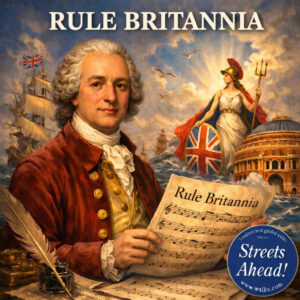
Thomas Arne, the London composer who gave Britain “Rule, Britannia!”
And on that stirring note –that splendid note – we have lift-off. Up she goes, your daily fix on this day, Thursday, March 12th, 2026.
At no little risk of belabouring the obvious, Rule Britannia is one of the most famous patriotic songs ever written.
The anthem of maritime Britain.
The tune that still brings the house down every summer at the Last Night of the Proms.
And it was written by… a Covent Garden undertaker’s son.
Now that’s a London story.
So that’s where we’re going. Covent Garden.
Early morning.
Market carts rattling over the cobbles.
Porters shouting.
Flower girls laughing.
Theatre folk drifting home after a long night at Drury Lane.
And in a house in King Street,
on this day in 1710,
a boy is born.
His name is Thomas Arne.
You may not recognise the name.
But you certainly know the tune he wrote.
Rule, Britannia! Britannia rule the waves!
Britons never, never, never shall be slaves.
Yes. That one.
The great chest-thumping anthem of Britain’s age of sail.
The composer of that tune was London through and through.
From the get-go.
So, yes, born in Covent Garden. Baptised at St Paul’s Covent Garden.
Living his life in the tight little orbit of the West End theatres – Drury Lane, Bow Street, Lincoln’s Inn Fields.
His father was an upholsterer and undertaker.
A solid, respectable trade.
The sort of trade that meant young Thomas was expected to become something sensible.
Preferably a lawyer.
But Thomas had other ideas.
As a boy he was sent off to Eton College.
And there he drove everyone half mad by playing the recorder at all hours.
At home he practised the spinet secretly at night,
muffling the strings so no one would hear him.
And when he wanted to sneak into the opera?
He borrowed a servant’s uniform and slipped in disguised as one of the staff.
Now that’s dedication.
Eventually his father gave in. Music had him.
There was no stopping it.
And where better to make a musical career than the theatres of London?
Arne began composing for the stage in the early 1730s.
Right in the thick of theatreland.
Drury Lane. Covent Garden. Lincoln’s Inn Fields.
He lived in Great Queen Street, then near Craven Buildings,
later Bow Street.
If you plotted his addresses on a map it would look like a tight little circle around the West End stages.
And he quickly became one of London’s most successful theatrical composers.
He wrote music for comedies, operas, Shakespeare revivals. Songs audiences walked out of the theatre humming.
He set Shakespeare lyrics like “Under the Greenwood Tree.”
He wrote “Where the bee sucks, there suck I.”
But the song that would make him immortal came about in a rather curious way.
In 1740, a masque was commissioned by Frederick, Prince of Wales.
Now Frederick was the son of King George II.
But father and son did not get along.
Not at all.
Frederick had effectively set up his own rival court.
And his country seat
was Cliveden House,
on the Thames.
There, in the gardens,
a grand entertainment was planned.
The occasion?
The third birthday of the prince’s daughter,
Princess Augusta.
Yes.
One of the most patriotic songs ever written was first performed at a birthday party for a three-year-old.
The masque was called Alfred.
The Alfred in question was
King Alfred the Great,
the Saxon ruler who defended England against Viking invasion.
The message was clear enough.
Britain,
like Alfred’s England,
must remain strong,
independent, unconquered.
The words were written by the poet James Thomson.
Arne supplied the music.
And during the performance
a tenor stepped forward
and sang a brand-new song.
Rule, Britannia! Britannia rule the waves.
Britons never, never, never shall be slaves.
The audience loved it.
Within a few years the song had escaped from the masque entirely.
It was sung in London concerts. Performed in pleasure gardens like Vauxhall Gardens.
Taken up by audiences who knew a good tune when they heard one.
And the timing could not have been better.
Britain was discovering its destiny at sea.
Trade. Empire. Naval power.
Just the year before Britain had gone to war with Spain in the War of Jenkins’ Ear.
Sea power mattered.
So when audiences heard the line
Britannia rule the waves
it sounded less like a theatre lyric and more like a national declaration.
There’s another delicious irony here.
Arne was a Roman Catholic.
Which in eighteenth-century Britain meant certain doors remained firmly closed to him.
He never held the
official royal musical posts that other composers enjoyed.
Yet this Catholic
Covent Garden composer
ended up writing two of Britain’s great patriotic musical emblems.
Rule Britannia.
And a setting of God Save the King.
Arne went on composing for decades –
operas, theatre music,
songs for London’s pleasure gardens. He even earned a Doctorate of Music from Oxford.
But like many theatrical composers his fortunes rose and fell with fashion.
By the end of his life he was struggling financially.
He reconciled with his estranged wife in 1777.
And not long afterwards he fell ill.
Thomas Arne died in Bow Street, Covent Garden, in 1778.
He died while talking about music.
He was buried nearby in St Paul’s Churchyard, Covent Garden.
The Actors’ Church.
Right in the middle of the theatre world that had made him.
And today, if you wander through Covent Garden,
you’re walking the same streets where the composer of Rule Britannia lived and worked.
King Street.
Bow Street.
Drury Lane.
Lincoln’s Inn Fields.
Not bad for the undertaker’s son who sneaked into the opera disguised as a servant.
And who wrote a tune that still brings thousands of people to their feet every summer at the Royal Albert Hall.
Rule, Britannia indeed.
And that’s where we leave it today.
This morning we had lift-off.
Tomorrow we have touchdown.
Because exactly a hundred years ago tomorrow –
March 13th, 1926 –
a small aeroplane came down at a London airfield in Edgware.
The pilot climbed out.
He’d just flown 16,000 miles.
London… to Cape Town… and back again.
His name was Alan Cobham.
And tomorrow we’ll tell the story of the flight that helped open the skies between London and Africa.
So it’s chocks away. And for a send off: Here’s to good walking and Good Londoning. See you tomorrow.