
What is the history behind London’s abandoned Tube stations?
Date post added: 12th May 2026
You may well have felt abandoned by the London tube service from time to time. You know those times when you’re in a rush and the next train is a whole ten minutes away.
Then there are those occasions when you’re jostling for space on the underground platform and squeezing yourself into a totally packed tube carriage. There’s something so London about spending an entire tube journey with your nose nestled in a stranger’s armpit, yet you say nothing to each other.
But did you know there are scores of underground stations devoid of crowds and hustle? A hidden network of abandoned tube stations that lay dormant – even at rush hour. Some were victims of progress, others of poor planning and a few simply never quite found their audience.
These disused stations are filled with curious tales, wartime secrets and the occasional ghostly visitor. We explore a selection of them here.
How many abandoned tube stations are there in London?
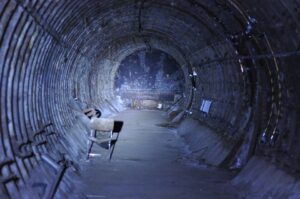
“Abandoned tunnel Aldwych tube station” by generalising is licensed under CC BY-SA 2.0.

There’s around 40-45 abandoned London underground stations. The precise number depends on your definition of ‘abandoned.’ And your definition of ‘tube station’ to be honest.
The London Underground’s had over 300 stations in its history. So while 40-odd abandoned stations might sound like a lot, they’re really just the leftovers of a network that’s constantly evolved for more than 150 years.
13 abandoned London underground stations
Let’s explore the stories of these hidden tube stations. Places where trains once stopped, passengers once hurried and now… nothing.
Aldwych
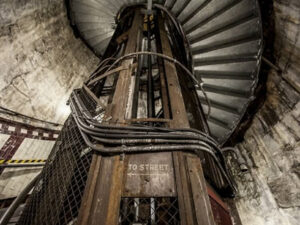
Aldwych station began life in 1907. At that point, it was named Strand as it was built on the site of the Royal Strand Theatre which had been demolished a couple of years earlier. It was designed by architect, Leslie Green, who was responsible for several underground stations at that time.
Originally, it was part of the newly formed Great Northern Piccadilly and Brompton Railway. The ambitious plan was to create a main route linking Piccadilly Circus, Leicester Square, Covent Garden and Holborn. But poor old Strand, was left dangling on a short, slightly awkward branch line at the end of the Piccadilly line.
So Aldwych became one of the Underground’s least-used stations. It never quite justified its existence and closed in 1994.
British Museum
“British Museum tube 2004” by Gordon Joly is licensed under CC BY-SA 3.0.

British Museum station opened on High Holborn in 1900. And yes, Holborn station is also on High Holborn. It’s just across the street to the east. British Museum was on the Central Line whilst Holborn was, and still is, on the Piccadilly Line. But there was no link between them. Why? Because British Museum was run by the Central London Railway and Holborn was run by the Great Northern, Piccadilly and Brompton Railway. They couldn’t align, so passengers had to get out and one station and walk along the road to the other one if they wanted to change lines.
The low-key rivalry between them meant a stand off. Since Holborn was better connected, British Museum shut in 1933.
However, it did serve a special purpose in the Second World War. One platform was bricked up and converted into a deep-level shelter to protect people from the Blitz. And train tunnels housed precious British Museum artefacts, including the Elgin Marbles.
Brompton Road
Brompton Road was on the Piccadilly line, back when it was still called the Great Northern, Piccadilly & Brompton Railway. It lay between Knightsbridge and South Kensington stations. And that was what sealed is fate. As it was so close to its neighbouring tube stations, Brompton Road closed in 1934 due to low usage
You can catch a glimpse of its side entrance and distinct tiling if you peer down Cottage Place. As it’s positioned in a prime London spot, it’s gone the way of so many others. It’s now a fancy apartment block.
But Brompton Road came into its own during the Second World War. It was the Royal Artillery’s anti-aircraft room for Central London. Its abandoned platforms became makeshift offices with sleeping quarters up above.
Charing Cross
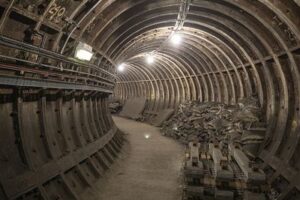
“Hidden London – Charing Cross tube station abandoned Jubilee Line platforms” by steve_w is licensed under CC BY-SA 2.0.

Yes, we know a Charing Cross underground station exists. But there’s more to it than meets the current eye. It has disused platforms right under Trafalgar Square.
There were lofty ambitions for Charing Cross. It was the terminus of the Jubilee Line from 1979 to 1999. The intention was to extend the line from Charing Cross to Lewisham. But the Docklands regeneration in the 1980s changed that. Instead, the Jubilee Line swerved past Charing Cross. It went from Green Park (the stop before Charing Cross) to Waterloo and onto Docklands and Stratford.
City Road
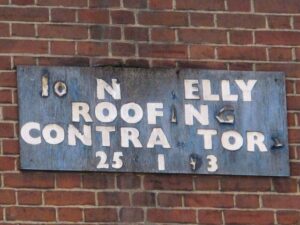
“Ghost sign on the remains of the (former) City Road tube station, City Road / Central Street / Moreland Street, EC1” by Mike Quinn is licensed under CC BY-SA 2.0.

Opened in 1901 on the City & South London Railway, City Road tube station struggled from the start. Its close proximity to nearby stops like Old Street and Angel, meant low usage. Passenger numbers never quite picked up and it closed in 1922.
Most of City Road station was demolished in the 1960s. Only a lift shaft remained until 2017 when it was turned into an energy centre.
Down Street
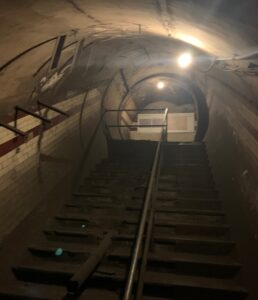
“Stairs at Down Street Underground station in Mayfair, London in March 2023” by Dorkingland is licensed under CC BY-SA 4.0.
.jpg)
Down Street station survived only 25 years and closed in 1932. It suffered a similar fate to Brompton Road. It was close to both Hyde Park Corner and Dover Street (Green Park as we know it today). Being the least used of the three, Down Street was the station to close.
And given that its local residents were decidedly wealthy, they preferred not to rub shoulders with the masses on the tube anyway. Before you shed a tear for poor, abandoned Down Street, it did have its time to shine during the Second World War. It was used as a temporary wartime shelter by Winston Churchill before the Cabinet War Rooms were ready for use. He referred to it as “The Barn.”
Highgate
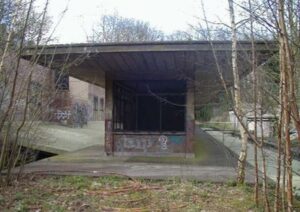
“Highgate Underground station abandoned high level platforms” by Hywel Williams is licensed under CC BY-SA 2.0.

The existing Highgate station is on the High Barnet branch of the Northern line. It opened in 1867 as part of the Great Northern Railway. But there’s another part of Highgate underground station that’s been abandoned (by humans anyway).
In 1935, there was a proposal to extend the tube lines further across North London (Finsbury Park, Edgware, High Barnet and Alexandra Palace). It was called the Northern Heights project. New deep-level platforms and tunnels were constructed at Highgate as part of this rail extension. But the war stopped the project in its tracks. The new parts of the tube station weren’t used except as deep level shelters. And here’s a fun fact. TV host and former mayor, Jerry Springer, was born in Highgate station in 1944 when it was being used as a wartime shelter.
Now, those abandoned platforms and tunnels at Highgate have been reclaimed by nature. It’s a protected habitat for several species of bat.
King William Street
King William Street was the original northern terminus of the City & South London Railway. That’s the Northern Line in today’s money. It was the first successful deep-level underground railway in London. It ran south from the City to Stockwell at the end of the line. Or at least it did for ten years (1890-1910). King William Street station was closed in 1900. The line was extended north, towards Moorgate, via a different route.
You can still see a plaque at the site of the old station. It’s slightly south of Monument station, on Monument Street (just off King William Street).
Mark Lane
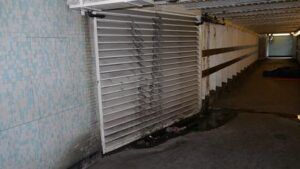
“Mark Lane Disused Tube Station” by J WILLIAMS is licensed under CC BY-SA 2.0.
.jpg)
At one time, there was a wealth of tube stations around this part of the City. From recognisable names including Cannon Street, Monument and Aldgate East, to lesser ones including St Mary’s (see below), Tower of London and Mark Lane. Tower of London only lasted two years and was combined with Mark Lane. But Mark Lane was pretty small and demand in that area was high. It was closed in 1967 and replaced by Tower Hill underground station.
However, Mark Lane lives on in part. Look out for the entrance to Mark Lane tube station at the point where Byward Street turns into Tower Hill.
Marlborough Road
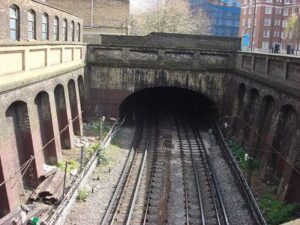
“Marlborough Road abandoned tube station” by Oxyman is licensed under CC BY-SA 3.0.

A station on the Metropolitan Line, Marlborough Road lasted from 1868 to 1939. It was closed when that section of the line between Finchley Road and Baker Street was upgraded. At that point it was the Bakerloo line, but it’s now the Jubilee Line. The original Swiss Cottage and Lord’s station were closed at the same time, for the same reason.
Marlborough Road still stands though. The building on the corner of Finchley Road and Queen’s Grove is now a power substation.
South Kentish Town
Now this was an underground station with poor planning from the start.
It was opened in 1907 by the Charing Cross, Euston & Hampstead Railway. Its intended name was Castle Road. But a decision was made to change that to South Kentish Town, just before it opened. But the Leslie Green designed tiles had already been laid to spell out Castle Road. A quick paint job ensued.
In June 1924, South Kentish Town was closed temporarily due to strike action at Lots Road Power Station. It wasn’t missed much, so it never reopened. Another demise due to low passenger use. The station building still stands on Kentish Town Road at the intersection with Royal College Street.
St Mary’s

Another East London tube station, St Mary’s stood between Aldgate East and Whitechapel. But when Aldgate East station was rebuilt in close proximity, St Mary’s was deemed obsolete.
During World War II it was used as an air raid shelter. But it was badly damaged and later demolished.
York Road
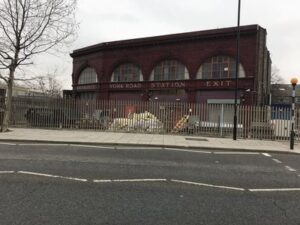
“York Road Underground Station” by Alistair Stewart is licensed under CC BY-SA 2.0.

Another underground station made more visually appealing by the hand of Leslie Green. It opened in 1906 and lasted until 1932. Nearby Kings Cross station pulled in way more punters. York Road couldn’t compete and it was shut down.
The good news is that Leslie Green’s distinctive oxblood tiling is still in good nick. York Road’s one of the most intact abandoned tube stations in London.
Which disused stations have been used in films?
Instead of closing busy tube stations or recreating them as sets, abandoned tube stations are ideal filming locations. Their old ticket halls, passageways and abandoned platforms have been utilised many times.
Aldwych tube station is a particularly popular filming location. Films and shows shot here include Skyfall, 28 Days Later and Atonement.
The closed-off sections of Charing Cross tube station are another favourite. Look out for them in Killing Eve, Harry Potter and the Deathly Hallows: Part 1 and Thor: The Dark World.
Which abandoned London tube stations are rumoured to be haunted?
The London Underground has long been fertile ground for ghost stories. And its ‘ghost stations’ may not be used by trains or passengers, but other beings still frequent them apparently.
There’s the ghost of Amen Ra that’s believed to be that of a cursed mummy put into the British Museum. The story goes that Amen Ra was furious at being unearthed. Their screaming spectre, complete with Egyptian headdress, has been spotted walking the station platforms.
Then there’s Aldwych (formerly Strand) which is known for its eerie atmosphere. Staff and visitors have reported strange noises, sudden drops in temperature and the unsettling feeling of being watched.
The tube system is one of the most haunted places in London. Read more ghost stories from the London underground
Let’s head down the tube
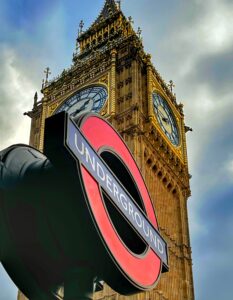
At London Walks, we revel in the unexpected and hidden aspects of the city. There are endless stories to be told of events that have occurred underground.
Fascinated by that? Come with us to explore the Lure of the Underground, starting at Baker Street tube station. Then there’s our special Hidden London tour which will reveal secret places around the city, from hidden palaces to abandoned tube stations.

Pippa Jackson
Pippa is a word nerd and content aficionado with a background of working in TV on both sides of the globe. She loves to discover and share the diverse and wonderful stories of her much-loved London. When she’s not writing blogs and articles, you’ll find her walking beside the Thames or even paddleboarding on it (in the finest of conditions only!) or enjoying a coffee in the sunshine with a good book.

David Tucker
David – the Seigneur of this favoured realm – broods over words, breeds enthusiasms and is “unmanageable.”* He’s a balterer, literary historian, university lecturer, journalist, logophile and lifelong thanatophobe. For good measure, he’s the doyen of London guides.