
Home to London – Alan Cobham’s Epic Flight
London calling.
London Walks connecting.
This… is London.
This is London Walks.
Streets ahead.
Story time. History time.
Top of the morning to you London Walkers.
And here it is, here’s your daily London fix.
Coming right out of the skies it is.
Picture the scene.
A grey March sky over north London.
A cold wind pushing across the fields.
And thousands of Londoners craning their necks,
staring up into the sky.
Because somewhere up there, out of the clouds, a tiny speck is coming home.
And not just from Paris.
Not just from Rome.
From Cape Town.
Seven thousand miles away.
And the man flying that aeroplane is one of the great aviation pioneers of the age –
Sir Alan Cobham.
And today’s the anniversary of the moment he came back.
March 13th, 1926.
Yes, exactly a hundred years ago.
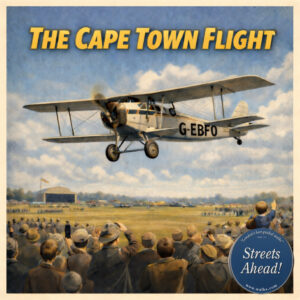
Sir Alan Cobham returns to Stag Lane Aerodrome, Edgware on 13 March 1926 after completing his pioneering London–Cape Town flight.
The day London welcomed home one of the most astonishing flights the world had ever seen.
Now today, flying from London to Cape Town is, well, routine.
You sit in seat 42A,
watch two films,
complain about the chicken
or the pasta,
and wake up in South Africa.
But in 1926?
It was like flying to the Moon.
Aircraft were fragile.
Navigation was primitive.
Weather forecasts were guesswork. And large stretches of Africa had almost no airfields at all.
But Cobham believed something very bold.
He believed long-distance air travel was the future.
So he decided to prove it.
His aircraft was
a de Havilland DH.50,
a single-engine biplane.
Open cockpit.
Wooden frame.
Fabric wings.
The sort of aircraft that looks today as though it might blow away in a stiff breeze.
Its registration number was G-EBFO.
G for Great Britain. EBFO – E – B -F – O was the individual aircraft code.
G-EBFO, that bureaucratese you can take or leave.
What gets my vote – and surely yours – is the rather proud name painted on its side.
City of London.
Which is fitting.
Because this was very much a London story.
Cobham himself was a Londoner, born in Camberwell.
And his great adventure began from Stag Lane Aerodrome at Edgware, a grassy north London airfield that in the 1920s was one of the capital’s gateways to the sky.
So off he went.
That was four months earlier.
November 1925.
Took off and flew Southwards.
France.
The Mediterranean.
Across North Africa.
Down the Nile.
Across deserts.
Across jungles.
Across enormous distances where, if the engine failed,
rescue might be days or weeks away.
Sometimes he landed on proper airfields.
Sometimes he landed on rough strips hacked out of bush.
Sometimes he landed in places where crowds had never seen an aeroplane before.
Imagine those moments.
Villagers gathering.
Children staring.
A machine from the sky descending out of the clouds.
Cobham pressed on.
Sudan.
Kenya.
Tanganyika.
And finally,
after weeks of flying,
he reached Cape Town.
But the story wasn’t finished.
Because he had to get home.
And that journey north again was just as dangerous.
Weather.
Mechanical problems.
Navigation.
And always the sheer remoteness of the landscape beneath him.
But Cobham kept going.
And eventually,
after more than
20,000 miles of flying,
the City of London turned its nose toward home.
Toward England.
Toward London.
And toward the moment we’re remembering today.
Because on March 13th, 1926, the little biplane appeared once again over the fields of Edgware, returning to Stag Lane Aerodrome, the very place it had departed four months earlier.
These days Edgware is suburban north London.
Buses.
Housing estates.
The A41 roaring with traffic.
But in the 1920s it was open country.
Fields.
Grass runways.
Hangars.
And on that March day in 1926 the place was absolutely packed.
Thousands of people had come to see the returning hero.
Remember, aviation was still magical then.
Most people had never been inside an aeroplane.
Many had barely seen one.
And here was a man who had just flown to Africa and back.
The crowd waited.
Scanning the sky.
And then somebody pointed.
A speck.
A tiny shape over the fields.
Growing larger.
The buzz of an engine.
The unmistakable outline of a biplane.
Cobham was home.
The City of London circled the aerodrome.
Then dropped lower.
Lower.
And finally the wheels touched the grass.
Flight complete.
London to Cape Town.
And back again.
A roar went up from the crowd.
Cobham climbed out of the cockpit to a hero’s welcome.
Within months he would be knighted.
From that moment on he was
Sir Alan Cobham.
And he didn’t stop there.
Cobham went on to pioneer something that still keeps modern aviation moving today.
Air-to-air refuelling.
The idea that aircraft could refuel each other in mid-air.
A breakthrough that made long-distance aviation and modern military operations possible.
He also created the famous Cobham Flying Circus,
a travelling air display that introduced millions of Britons to aviation in the 1930s.
But that March afternoon at Edgware remained one of his greatest moments.
A Londoner.
Coming home to London.
After proving that the world had suddenly become much, much smaller.
And that’s London.
A city where history happens in fields.
And then disappears beneath the suburbs.
Until somebody remembers the story.
And tells it again.
And tomorrow’s London Calling?
Well tomorrow we trade aeroplanes for comic opera.
Because on March 14th, 1885, Victorian London packed into the Savoy Theatre for the first performance of a brand-new musical extravaganza by
W. S. Gilbert and
Arthur Sullivan.
The title?
The Mikado.
And if you think that sounds respectable and dignified,
think again.
The story involves a wandering minstrel who
may or may not have already been executed,
a town where flirting is punishable by death,
and a Lord High Executioner
who would very much prefer not to execute anybody at all.
In other words, it is gloriously silly.
Victorian London absolutely adored it.
And tomorrow we’re heading to the Savoy to see why.
Expect satire.
Expect songs you’ll recognise.
And expect some very splendid nonsense indeed.
Until then…
well, here’s to no end of great Londoning.
See you tomorrow.