
Anerley Lodge, the first house here, was built by a Scottish businessman in the 1820s. They say ‘anerly’ is Scots dialect for lonely. Lonely no more as a railway was laid along the line of the short-lived Croydon canal.
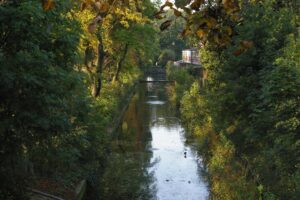
Photo: Christopher Hilton Creative Commons 2.0
Almost the only canal remnants are here to see as it headed up 28 locks from the Thames.
The surrounding skeleton streets took time to flesh out with houses – in one, the poet Walter de la Mare lived modestly commuting to his day job as oil company clerk. Slow growth left space for the Crystal Palace District cemetery. Opened in the 1870s with two chapels (one now deceased), it too has taken time to fill. In this attractive setting, legendary cricketer W.G.Grace is buried, as is Thomas Crapper of…toilet bowl fame.
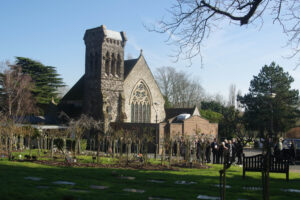
The far end of the cemetery leads to a path into South Norwood Country Park.
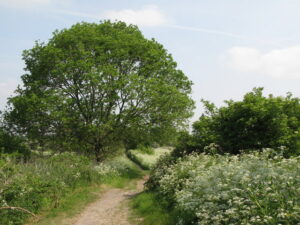 Rewilding isn’t so new. Hack up an old sewage works, fill and cover an old brick works, leave for 40 years – and this wonderful wilderness emerges. There’s a proliferation of plants and nearly 60 bird species including plenty on the lake. Emerge the other side to the home of Croydon’s football teams and Harriers to find its arena tram stop.
IT ALL COMES DOWN TO THE GUIDING
ant –
In full agreement with previous reviews…. and whether doing one or more the fourteen walks Charlie is able to make each walk stand alone. I am learning so much more about these areas and yet I have lived in London for many years. These walks are of interest to locals and visitors to London.
Jacky –
Sections 11 & 12: Sydenham Hill to Arena Tram
The afternoon stretch of the walk included a stroll through Crystal Palace District Cemetery: a mix of crumbling Victorian graves with illegible gravestones, together with modern black granite memorials and sparkling gold epitaphs. Having already walked past the blue-plaque house of Thomas Crapper (toilet bowl chap), we then saw his grave.
The remainder of the walk was mainly off-road. Once again, hard to believe you’re in London. The Norwood Country Park was very wild, with blackberries & bulrushes …. and yet another sewerage farm plus a heron on a pond (that mirror image North & South again).
I must give another big shout-out to our guide Charlie, ably assisted on this stretch by Mary, for the huge amount of work and research put into this “Ultimate London Walk”.
You don’t need to have done the previous sections of the walk. Each section is complete in itself. The guiding and organisation is excellent.
A B A –
Section 12 of the Ultimate London Walk September 2026
Once again, Charlie put together a fantastic route that beautifully contrasts urban living with green spaces, all based on his incredible research. We learned so much about the notable figures of the area, ranging from sanitaryware pioneers to watchmakers.
If you can complete all the sections, you gain even more context, as the southern sections mirror much of the social development seen in the northern parts. However, each walk easily stands on its own and doesn’t assume any prior knowledge of the area or subject matter.
The pre-walk information was also excellent. The detailed email regarding meeting points, potential toilet stops, and terrain made it easy to prepare and pack appropriately. Additionally, the group size was ideal, allowing everyone to hear clearly and walk at a comfortable pace without feeling rushed.
Finally, Charlie was an outstanding guide—attentive, passionate about sharing his knowledge, and very open to input from the group.
Melanie Goodwin –
Ghost signs, abandoned canals, sanitary ware, poetry, cricket and an assasination attempt on Queen Victoria – just a few of the wonderful nuggets from Charlie on this section of The Ultimate London Walk.
Dorothy MacDonald –
More surprises on this walk with the cemetery and surrounding streets and then the vast expanse of the lovely wild South Norwood Country Park. I’ve learned so much from Charlie on these walks about places I knew nothing about or didn’t even know existed, I look forward to the final 2 sections.
Mark Harden –
Charlie Forman has developed a terrific program, The Ultimate London Walk, which is a walk across Greater London. We have joined 4 sections of the walk and have seen parts of London that we had never seen before and certainly would not have seen the areas that we traversed. During the walks we learned the interesting history impacting each of the villages. Charlie brings the walk to life with his detailed research of the history of areas we walked and describing the pull of a growing Greater London, and the way communities were affected, have developed, and in many cases are protecting their green areas. We look forward to the remaining sections and are sure they will be just as engaging.